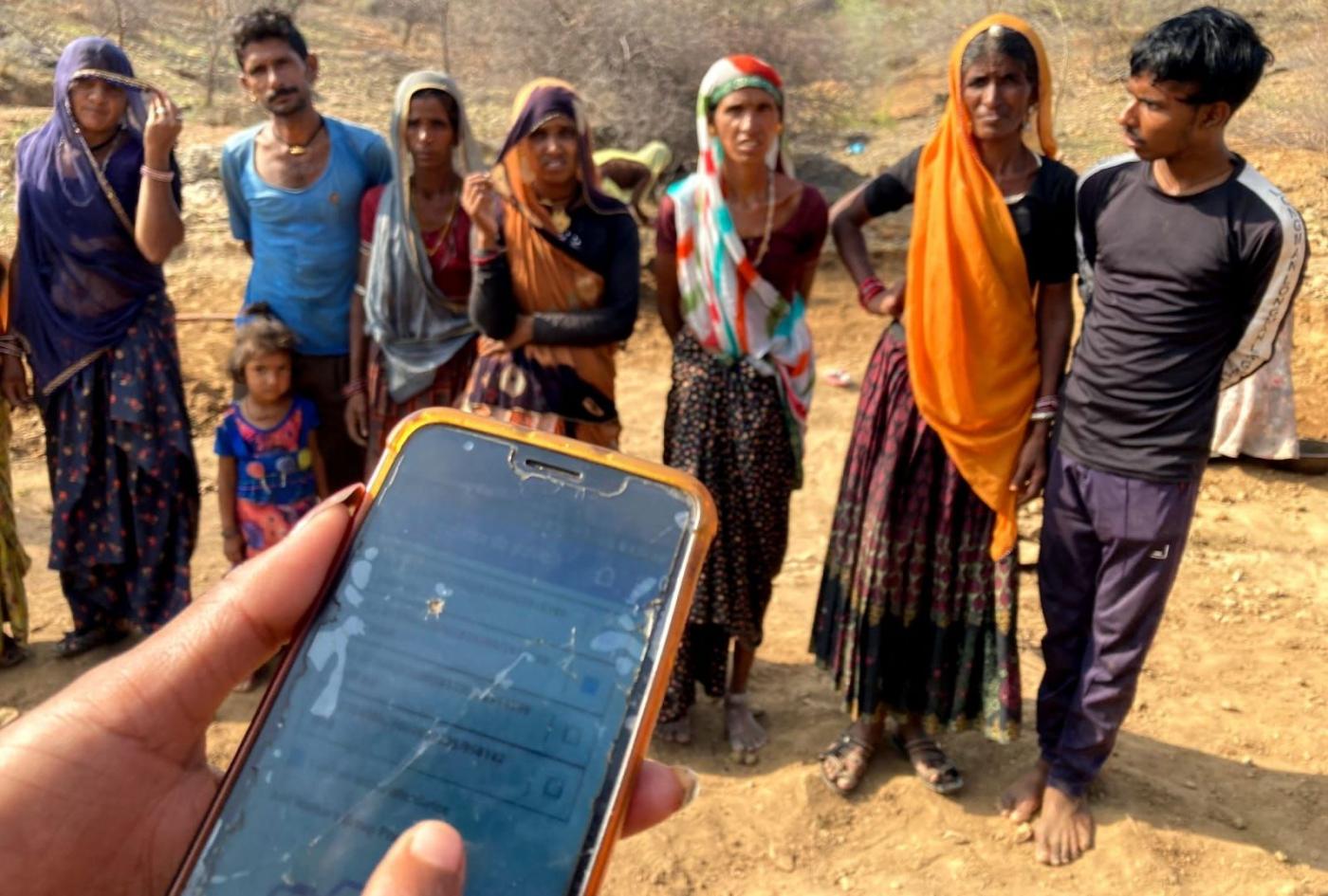
Aadhaar, app-based payments order to deprive 57% rural workers of NREGA wages

 
The civil rights network, NREGA Sangharsh Morcha (NSM), protesting against the Government of India (GoI) decision of compulsory aadhaar-based payments to rural workers, calling it a major blow to the National Rural Employment Guarantee Act (NREGA), has said that this comes at a time when budgetary allocation for NREGA has been reduced to just Rs 60,000 crore in 2023-24 -- less than Rs 50,000 crore, if we deduct wage arrears from 2022-23, and the lowest as proportion of GDP (0.2%) in the history of the programme.
Pointing out that the NREGA Mobile Monitoring System (NMMS) digital-attendance App was made compulsory from 1 January onwards, while the Aadhaar-Based Payment System (ABPS) was made compulsory from 1 February, NSM said in a statement, “The main objection to it is that a majority of NREGA workers are not ‘eligible’ for ABPS. They cannot be paid via ABPS as things stand, and many may not be eligible for a long time.”
Until now, the NREGA payment system allowed two modes of wage payment: “account based” and “aadhaar based”. The former is a plain bank transfer. The latter uses aadhaar as a financial address and sends money to the person’s “last Aadhaar-linked account”. For the aadhaar-based option to work, not only must the worker’s job card and bank account be seeded with aadhaar, the account has also to be connected to the National Payments Corporation of India (NPCI) mapper.
“This connection, known as mapping, can be very cumbersome, because it requires meeting stringent KYC/e-KYC requirements, resolving possible inconsistencies between the aadhaar database and the bank account, etc.”, said NSM in the statement released at a media conference in Delhi.
It regretted, “After many years of relentless push for 100% mapping of NREGA workers’ accounts, a majority of NREGA workers are still not eligible for ABPS. According to the Ministry of Rural Development’s (MoRD’s) MIS Report 1.1.9, only 43% of NREGA workers are eligible for ABPS”, adding, “In other words, the MoRD has created a situation where a majority of NREGA workers cannot be paid, if the 30 January order is enforced.”
The civil rights group wonders, “What does the MoRD propose to do about wages due to NREGA workers who are not eligible for ABPS? Are their wages going to be held up, illegally, until they are eligible? Are they going to be prevented from working the first place? Only the MoRD can answer these questions?”
It underlined, “There is no evidence that it works better than the account-based system for NREGA wage payments – on the contrary. A LibTech India study of 18 lakh wage invoices for the first half of 2021-22 showed that aadhaar-based wage transfers were no quicker than account-based transfers. Nor is there any evidence that the ABPS helps to prevent corruption – on the contrary. Evidence from the ground suggests that a new nexus between Micro ATMs, data entry operators and bank officials and facilitates last-mile corruption.”
Talking to media, Nikhil Dey of the Mazdoor Kisan Shakti Sangatha, pointing towards the ongoing 100 day protest in Delhi against the GoI move, said, “It is enormously difficult for NREGA workers to come to Delhi and protest, but are being forced to do so to resist the assault on NREGA through imposition of the NMMS , ABPS wage payment , budget cuts and delays in payment of wages.” The result is that, “NREGA workers of West Bengal have not been paid for more than a year.”
Yogendra Yadav of the Swaraj Abhiyan said, the measures being introduced by the MoRD are “a clear demonstration of the GoI attempt to hollow out a law without formally repealing a law. The fact that the MoRD issued an order mandating ABPS payments on the same day that the budge allocation was reduced is a clear indication of deliberate, illegal and immoral hurdles being imposed by the Government to ensure less funds are spent on the programme.”
Maheshwari Devi of the from Muzaffarpur District, Bihar, who is with the MGNREGA Mazdoor Union, shared the difficulties she faces as as a NREGA worker because of the NMMS. According to her, she reaches work at 9am, and is made to stay at the worksite till 4pm because her photo needs to be uploaded twice a day for her to get her wage.
She added, “There are numerous instances when workers have come to work and have finished their work, but their attendance is not marked for the day because of server and technical issues with the NMMS. Workers have been made to return home without wages for work already completed by them.”
Stating that she had worked for 6 days, but was marked attendance for one day and went to the Block Officer and the District Officer to complain against the “gaayab haazri” (missing attendance), and is nowhere in Delhi to be heard, she insisted, “The MoRD should stop imposing such hurdles on workers and instead increase NREGA entitlement to 300 days and ensure wages are paid within seven days, and through the app.”
Jean Dreze, who is visiting professor of the Ranchi University, said, the order issued by MoRD on mandating all NREGA payments to be routed through the ABPS alone was passed on the same day as the budget cut was allocated, and while the latter caught everyone’s attention the former did not. He noted, “Even though the MoRD has been pushing for ABPS, to date it has been able to only ensure that 43% of NREGA workers are eligible for ABPS payment.”
He predicted, “The enforcement of the order issued by MoRD on 30th January will result in the majority of MGNREGA workers not being paid their duly earned wages. And an even larger majority of workers will not know whether they are or are not eligible for ABPS. This is a truly shocking order and can destroy the programme.”
NSM demanded immediate removal of NMMS app that is "leading to denial of work and wages to workers", revocation of the order issued on 30th January 2023 mandating all payments to NREGA workers taking place through the ABPS, and putting in place a time bound action plan to ensure that all NREGA workers are paid their wages within 15 days of them completing work.

Comments

TRENDING

Disappearing schools: India's education landscape undergoing massive changes

   The other day, I received a message from education rights activist Mitra Ranjan, who claims that a whopping one lakh schools across India have been closed down or merged. This seemed unbelievable at first sight. The message from the activist, who is from the advocacy group Right to Education (RTE) Forum, states that this is happening as part of the implementation of the National Education Policy (NEP), 2020, which floated the idea of school integration/consolidation.

Inside an UnMute conversation: Reflections on media, civil society and my journey

I usually avoid being interviewed. I have always believed that journalists, especially in India, are generalists who may suddenly be assigned a “beat” they know little—sometimes nothing—about. Still, when my friend  Gagan Sethi , a well-known human rights activist, phoned a few weeks ago asking if I would join a podcast on  civil society  and the media, I agreed.

A Hindu alternative to Valentine's Day? 'Shiv-Parvati was first love marriage in Universe'

The other day, I was searching on Google a quote on Maha Shivratri which I wanted to send to someone, a confirmed Shiv Bhakt, quite close to me -- with an underlying message to act positively instead of being negative. On top of the search, I chanced upon an article in, imagine!, a Nashik Corporation site which offered me something very unusual.  I don't know who owns this site, for there is nothing on it in the About Us link. It merely says, the Nashik Corporation  site   "is an educational and news website of the municipal corporation. Today, education and payment of tax are completely online." It goes on to add, "So we provide some of the latest information about Property Tax, Water Tax, Marriage Certificate, Caste Certificate, etc. So all taxpayer can get all information of their municipal in a single place.some facts about legal and financial issues that different city corporations face, but I was least interested in them."  Surely, this didn't interest...

Overworked and threatened: Teachers caught in Gujarat’s electoral roll revision drive

I have in my hand a representation addressed to the Chief Electoral Officer (CEO), Gujarat, urging the Election Commission of India (ECI) to stop “atrocities on teachers and education in the name of election work.” The representation, submitted by Dr. Kanubhai Khadadiya of the All India Save Education Committee (AISEC), Gujarat chapter -- its contents matched  what a couple of teachers serving as Block Level Officers (BLOs) told me a couple of days esrlier during a recent visit to a close acquaintance.

'Shameful lies': Ambedkar defamed, Godse glorified? Dalit leader vows legal battle

A few days back, I was a little surprised to receive a Hindi article in plain text format from veteran Gujarat Dalit rights leader Valjibhai Patel , known for waging many legal battles under the banner of the Council of Social Justice (CSJ) on behalf of socially oppressed communities.

Whither GIFT City push? Housing supply soars in Mumbai, Hyderabad, Pune, not Ahmedabad

A  new report  by a firm describing itself as a "digital real estate transaction and advisory platform,"  Proptiger , states that the Mumbai Metropolitan Region (MMR) has been the largest contributor to housing units among India's top eight cities currently experiencing a real estate boom. Accounting for 26.9% of all new launches, it is followed by  Pune  with 18.7% and  Hyderabad  with 13.6%. These three cities collectively represented 59.2% of the new inventory introduced during the third quarter (July to September 2025), which is the focus of the report’s analysis. 

The tribal woman who carried freedom in her songs... and my family’s secret in her memory

It was a pleasant surprise to come across a short yet crisp article by the well-known Gujarat-based scholar Gaurang Jani , former head of the Sociology Department at Gujarat University , on a remarkable grand old lady of Vedcchi Ashram —an educational institute founded by Mahatma Gandhi in South Gujarat in the early years of the freedom movement.

It is? Modi perspires four times a day to ensure face glow? But why he loved ACs?

A former Gujarat government official recently shared a tweet   by Subramaniam Swamy where a video shows Prime Minister Narendra Modi telling school children in his hometown Vadnagar that their face would glow if they perspire four times a day. He suggested his face was glowing exactly because of this reason. I have no idea whether facial glow is linked with how many times you perspire in a day, but what I know is, Modi would profusely avoid any perspiration when he was Gujarat chief minister. Thus, in 2006, Modi undertook a fast in support of the Narmada project, which he said the Centre was not supporting. The fast, it was declared, lasted for about 51 hours. I don't recall which month it was, but to avoid perspiration, he got installed air conditions in the open, just next to the spot where he and his colleagues were undertaking fast for the Narmada dam. When some enterprising journalists tried watching the ACs, they were manhandled -- for it would show his fast in poor light. S...

India's Human Development Index loss due to inequality 'higher than' BRICS countries

  Fresh data released by the United Nations Development Programme (UNDP), released this month, show that while India ranks 130 out of 189 countries in human development index (HDI), with HDI value of 0.640 on a scale of 1, this is “below the average of 0.645 for countries in the medium human development group”, even though it is “above the average of 0.638 for countries in South Asia.”