
Rajasthan cops 'halt' Gujarat Dalit women's rally: homage to untouchability victim boy

 
In a surprise move, the Rajasthan police stopped a Dalit women's rally from Gujarat on the borders after it crossed Gujarat alleging that it would "disturb peace" in village Surana, Jalore district, where the gruesome incident of death of a Dalit boy took place on August 13 after he was brutally beaten up by his teacher on touching the drinking water pot.
Sources said, while the Gujarat government had "no objection" in allowing the rally, which originated from the Dalit Shakti Kendra (DSK), an empowerment-cut-technical institute for teens founded by human rights leader Martin Macwan, on September 24 morning, the Rajasthan police stopped it for two and a half hours before allowing it to proceed to Surana.
The decision to take out a women's rally was taken at a DSK meeting on September 5 following a condolence meeting of the NGO Navsarjan Trust, also founded by Macwan, activists committed to work against caste-based discrimination, organised to offer condolences to Dalit boy Indra Kumar Meghwal.
Claimed an NGO communique, simultaneous condolences were held in 1508 villages of 12 states of India, where people also donated Rs 2,77,229 to support the parents of the Dalit. The condolence meetings also discussed the "brutal mindset of teachers discriminating Dalit students in the school, and instead of building a strong nation, they are segregating children based on caste", the NGO said.
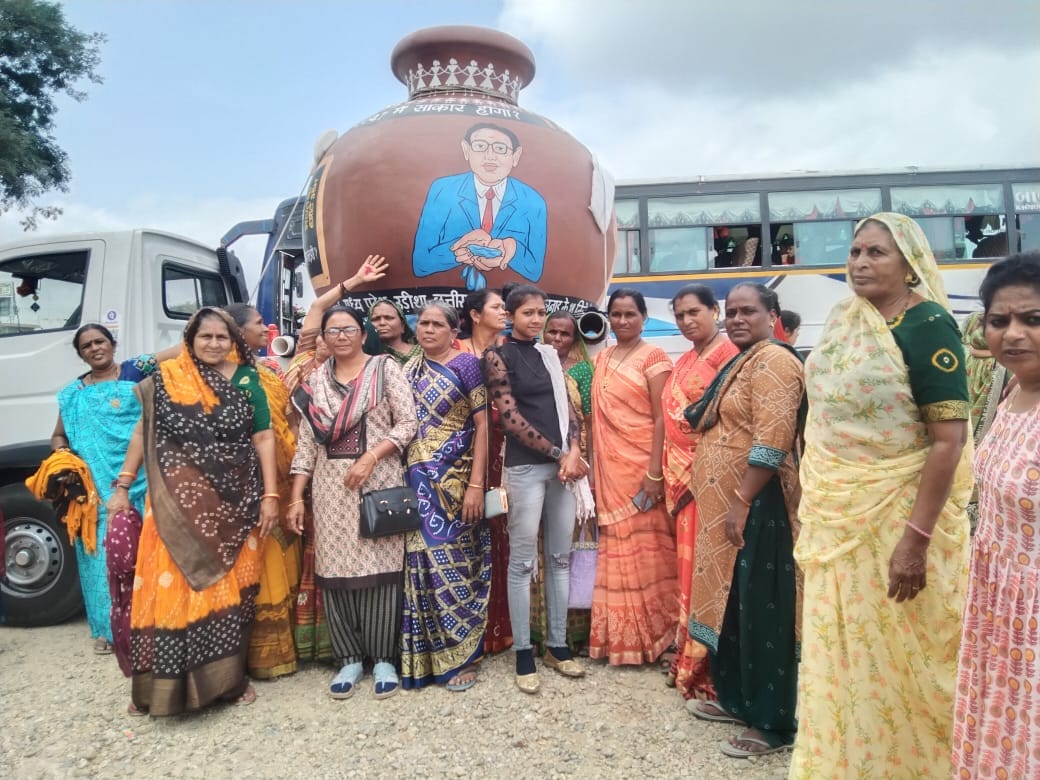
According to the NGO, the rally, which consisted of just 275 women, was held on September 24, which also happens to be the 90th anniversary of the Poona Pact, where Mahatma Gandhi promised an untouchability free India to Dr BR Ambedkar. In exchange, Ambedkar gave up his demand for separate electorate for the Dalits.
The 275 women were stopped by Rajasthan police near Raniwara village on the border of Gujarat and Rajasthan. They carried with them a 7 feet pot having the public donation of Rs 2,77,229 to the parents of Meghwal. All 275 women sat on a dharna on the road against the act of police and "for violating the fundamental right of peaceful protest."
The 7 feet tall drinking water pot was especially built with the painted images of Indra Kumar Megwal and Ambedkar, who took water from Chavdar lake of Mahad as a mark of symbolic protest against untouchability. "The pot was finally allowed be kept in the old village house of the Dalit boy as a memorial, and also to understand the reality of Dalit children", the source said.

Comments

TRENDING

Caste, class, and Patidar agitation: Veteran academic 'unearths' Gujarat’s social history

Recently, I was talking with a veteran Gujarat-based academic who is the author of several books, including "Social Movements in India: A Review of Literature", "Untouchability in Rural India", "Public Health and Urban Development: The Study of Surat Plague", and "Dalit Identity and Politics", apart from many erudite articles and papers in research and popular journals.

Alang emerges as primary graveyard for sanctioned 'shadow fleet' tankers as legal pressure mounts

In a significant shift that appears to be reshaping the global maritime demolition landscape, oil tankers from the so-called "short fleet" — vessels operating under international sanctions — are reported to be increasingly making their final voyage to the shipbreaking yards of Alang-Sosiya in Gujarat's Bhavnagar district , industry data reveals.

From Dimagi Naxal to Kartikeya: The curious journey of a political expression

Following the Prime Minister’s “Dimagi Naxal” remark, there appears to have been a huge backlash, especially from protagonists of the “Cockroach Janata Party.” The term is being variously interpreted as a move to “isolate” dissidents, following the claim of a successful campaign against Naxalite violence. Social media is full of “Dimagi Naxal Party” memes, making a joke of an expression used, perhaps for the first time in India.