New data released by the Census of India have suggested a strange fact. While the percentage of those who have been identified as “seeking” jobs or are “available for work” out of the total population in the age-group 15-59 in Gujarat is one of the lowest in India – suggesting a much lower unemployment rate than most Indian states – this does not tell the full story. No doubt, both in the working age-group of 15-59 and in the “job-seeking” younger age-group of 20-25, Gujarat appears to have fared considerably better than the rest of India. Thus, as against nearly seven per cent job-seekers in the country as a whole out of the total population of about 73 crore in the age-group 15-59, Gujarat’s jobseekers are just 2.61 per cent – or less than half of the country – in its population of 3.8 crore in this age-group. In the age-group 20-24, too, the situation is more or less than same. In this age group, there are nearly four per cent job seekers in Gujarat compared to 8.6 per cent of the country as a whole. However, a deeper look into the working population figures reveals something alarming.
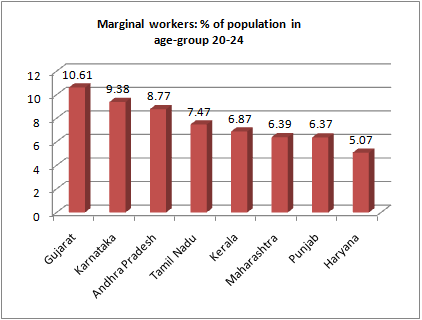
Gujarat has a much higher percentage of marginal workers than several other states. Not just this. Gujarat has one of the highest incidence of child labour – identified as “main workers” in the age-group 10-14 — in the country. But first about marginal workers, who have been identified by the census as those getting work between three and six months in a year. The census figures show that out of the total population of 57.81 lakh in the age group 20-24 in Gujarat, as many as 6.14 lakh – or 10.61 per cent – work as “marginal workers”. The states which have lower percentage of marginal workers than Gujarat in this age group are known for their relatively better economic performance, too. There are – Karnataka (9.38 per cent), Andhra Pradesh (8.77 per cent), Tamil Nadu (7.74 per cent), Kerala (6.87 per cent), Punjab (6.37 per cent), and Haryana (5.07 per cent).
Gujarat has a much higher percentage of marginal workers than several other states. Not just this. Gujarat has one of the highest incidence of child labour – identified as “main workers” in the age-group 10-14 — in the country. But first about marginal workers, who have been identified by the census as those getting work between three and six months in a year. The census figures show that out of the total population of 57.81 lakh in the age group 20-24 in Gujarat, as many as 6.14 lakh – or 10.61 per cent – work as “marginal workers”. The states which have lower percentage of marginal workers than Gujarat in this age group are known for their relatively better economic performance, too. There are – Karnataka (9.38 per cent), Andhra Pradesh (8.77 per cent), Tamil Nadu (7.74 per cent), Kerala (6.87 per cent), Punjab (6.37 per cent), and Haryana (5.07 per cent).
Of course, the all-India per cent of marginal workers is slightly higher than that of Gujarat – 12.36 per cent in a population 11.14 crore in the age-group 20-24, but this is mainly on account of the fact that the states traditionally known as “Bimaru” experience a much higher percentage of marginal workers. While Himachal Pradesh has the highest percentage of marginal workers than any other state of India in this age group, around 36 per cent, this is followed by Jharkhand (24 per cent), Odisha (21 per cent), Chhattisgarh (20 per cent), Rajasthan (17 per cent), Madhya Pradesh (17 per cent), Assam (15 per cent), Uttar Pradesh (13 per cent), and West Bengal (13 per cent).
It is not without significance that the National Sample Survey Organization (NSSO), India’s premier data collection centre, almost simultaneously found a high incidence of underemployment in Gujarat in a report released in January 2014. Taking a cue from the need to take a look at underemployment afresh, for the first time, the NSSO report, “Employment and Unemployment Situation in India, 2011-12”, analyzed data of persons who, in some way, fell in the category of marginal workers – the NSSO said underemployed were those who failed to get employment “more or less regularly throughout the year”.

It is not without significance that the National Sample Survey Organization (NSSO), India’s premier data collection centre, almost simultaneously found a high incidence of underemployment in Gujarat in a report released in January 2014. Taking a cue from the need to take a look at underemployment afresh, for the first time, the NSSO report, “Employment and Unemployment Situation in India, 2011-12”, analyzed data of persons who, in some way, fell in the category of marginal workers – the NSSO said underemployed were those who failed to get employment “more or less regularly throughout the year”.

The NSSO finds that in Gujarat, this predicament befell 11.6 per cent workers in the age group 15 years and above in the rural areas, and 5.8 per cent workers in the same age group in the urban areas. This is higher than the national average – which was 10.6 per cent in the rural areas and 5.7 per cent in the urban areas. A comparison with other Indian states suggests that there was lower underemployment than Gujarat’s in rural areas of 12 major Indian states out of 20, and seven states in the urban areas.
Thus, as against 11.6 per cent underemployment in Gujarat’s rural areas, major states with lower underemployment ratio were Andhra Pradesh (8.8 per cent), Assam (8.5 per cent), Bihar (10 per cent), Haryana (9 per cent), Himachal Pradesh (5.6 per cent), Jammu & Kashmir (7 per cent), Karnataka (4.8 per cent), Maharashtra (10.3 per cent), Odisha (9.8 per cent), Punjab (5.8 per cent), Uttarakhand (9.7 per cent), and Uttar Pradesh (8.5 per cent). In the urban areas, too, the states with a higher underemployment rate than Gujarat (5.8 per cent) were Andhra Pradesh (3 per cent), Assam (5.3 per cent), Haryana (2.9 per cent), Himachal Pradesh (4.4 per cent), Jammu & Kashmir (5.5 per cent), Punjab (3.2 per cent), and West Bengal (5.2 per cent).
A recent study, “India Labour and Employment Report 2014”, prepared by the Academic Foundation, New Delhi, in association with the Institute for Human Development, says that underemployment and marginalization of labour is a phenomenon found quite prevalent in developing countries, where people are generally less unemployed because they are desperately in need of work and there is no social protection to help them out. The study underlines, “As is typical for a poor and developing economy, most workers in India cannot afford to be unemployed, hence the level of open unemployment is quite low at 2.7 per cent.” Suggesting that people more workers are underemployed, it adds, “Even the more comprehensive current daily status (CDS) measure of unemployment reaches only 5.6 per cent.”
Thus, as against 11.6 per cent underemployment in Gujarat’s rural areas, major states with lower underemployment ratio were Andhra Pradesh (8.8 per cent), Assam (8.5 per cent), Bihar (10 per cent), Haryana (9 per cent), Himachal Pradesh (5.6 per cent), Jammu & Kashmir (7 per cent), Karnataka (4.8 per cent), Maharashtra (10.3 per cent), Odisha (9.8 per cent), Punjab (5.8 per cent), Uttarakhand (9.7 per cent), and Uttar Pradesh (8.5 per cent). In the urban areas, too, the states with a higher underemployment rate than Gujarat (5.8 per cent) were Andhra Pradesh (3 per cent), Assam (5.3 per cent), Haryana (2.9 per cent), Himachal Pradesh (4.4 per cent), Jammu & Kashmir (5.5 per cent), Punjab (3.2 per cent), and West Bengal (5.2 per cent).
A recent study, “India Labour and Employment Report 2014”, prepared by the Academic Foundation, New Delhi, in association with the Institute for Human Development, says that underemployment and marginalization of labour is a phenomenon found quite prevalent in developing countries, where people are generally less unemployed because they are desperately in need of work and there is no social protection to help them out. The study underlines, “As is typical for a poor and developing economy, most workers in India cannot afford to be unemployed, hence the level of open unemployment is quite low at 2.7 per cent.” Suggesting that people more workers are underemployed, it adds, “Even the more comprehensive current daily status (CDS) measure of unemployment reaches only 5.6 per cent.”
It is poverty, again, which forces a still younger population into jobs, and this is more true of Gujarat as compared to elsewhere in India. Thus, in Gujarat, in the two “preceding” groups, 10 to 14 years and 15 to 19 years, when children are supposed to study, there is a much higher incidence of workers. The Census of India figures show that in the age-group 10 to 14, there are 2.05 lakh “main workers” in Gujarat – which means that Gujarat has a proportionately higher per cent of child labour in this age group, 3.33 per cent, this age group (61.49 lakh), than the country as whole. A comparison with the country as a whole suggests that there are 2.44 per cent of child workers India (32.44 lakh in a population of 13.27 crore).
What is interesting is that all 20 major Indian states, except for Andhra Pradesh and Karnataka, have a lower proportion of child labour than that of Gujarat. While Andhra Pradesh has four per cent child workers and Karnataka has 3.48 per cent, Maharahshtra has 3.28 per cent, Punjab 2.59 per cent, West Bengal 2.06 per cent, Tamil Nadu 183 per cent, Haryana 1.46 per cent, Kerala 0.5 per cent, and so on. The Census of India figures find things equally alarming for the 15-19 age-group, which many child rights activists insist should be barred from doing any labour, as it is a school going age. In this age group, 21 per cent of Gujarat’s population (12.34 lakh out of 58.66 lakh) are “main workers”, compared to the all-India average of 14.69 per cent (1.77 crore out of 12.05 crore).
What is interesting is that all 20 major Indian states, except for Andhra Pradesh and Karnataka, have a lower proportion of child labour than that of Gujarat. While Andhra Pradesh has four per cent child workers and Karnataka has 3.48 per cent, Maharahshtra has 3.28 per cent, Punjab 2.59 per cent, West Bengal 2.06 per cent, Tamil Nadu 183 per cent, Haryana 1.46 per cent, Kerala 0.5 per cent, and so on. The Census of India figures find things equally alarming for the 15-19 age-group, which many child rights activists insist should be barred from doing any labour, as it is a school going age. In this age group, 21 per cent of Gujarat’s population (12.34 lakh out of 58.66 lakh) are “main workers”, compared to the all-India average of 14.69 per cent (1.77 crore out of 12.05 crore).
Comments
Post a Comment
NOTE: Hateful, abusive comments won't be published.