Anti-untouchability brass coin yatra to Delhi getting 'overwhelming' response: Macwan

 
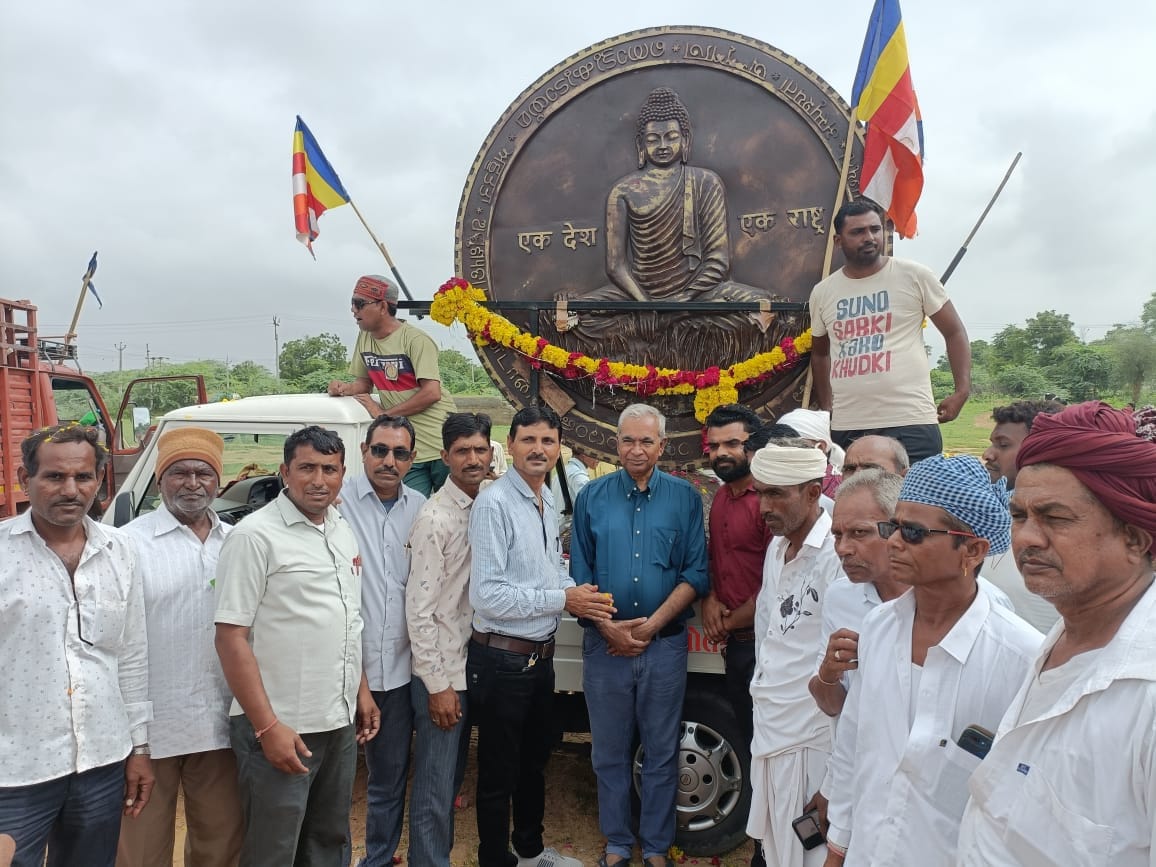
Gujarat’s top Dalit rights leader Martin Macwan, who is currently leading a week-long procession to Delhi carrying a 1,111 kg brass coin with the pointed question embossed on it, “Will the 1947 dream of untouchability free India be a reality in 2047?”, has reiterated that the removal of untouchability in India is Dalits’ primary concern, and not opposition to the new Parliament building.
The march began in Ahmedabad on August 1 at 8:00 am amidst refusal of the Gujarat police a day earlier refusing to give the permission for the procession, which involves a small truck carrying the huge brass coin, another one with an Ambedkar statue, two trucks full of about 25 lakh one rupee coins donated by Dalits across India, and six buses with 300 Dalit activists. The brass coin has the image of BR Ambedkar on one side, and of Lord Buddha, on the other.
Starting at the Dalit Shakti Kendra (DSK), founded by Macwan to provide technical-cum-empowerment training to the underprivileged teens off Ahmedabad, the march, which has passed through the rural areas of North Gujarat, is currently in Rajasthan. “We are getting overwhelming response”, claims Macwan “As we entered Rajasthan, we were supported a one-and-a-half kilometre long procession”, he said.
The march proposes to reach Delhi on August 7 via Haryana.
Addressing rural folk at one spot, Macwan said, “While it is true that Rs 20,000 crore, currently being spent for the new Parliament building, could have been better used for people’s welfare, we think removal of untouchability is a much bigger issue. In whichever building the Parliamentarians site, new or old, their primary concern should be ensure an untouchability-free India.”
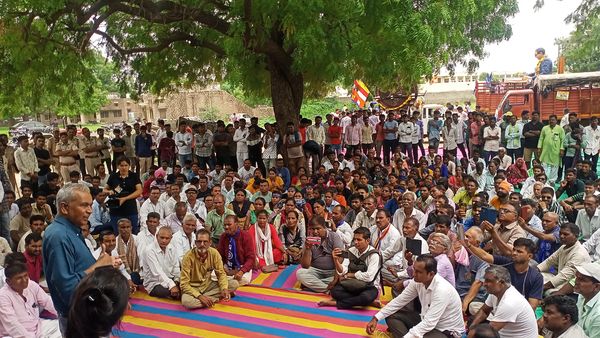
Stating that it is with this aim he and his supporters seek to hand over the huge brass coin to the President, the Vice-President, and the Lok Sabha speaker, he said, “We want the coin to be either placed in the new Parliament building or in its base. It should serve as a gross reminder that the Parliamentarians so far have failed to fulfill the Constitutional obligation of removing removing untouchability.”
Explaining what he proposes to do with about 25 lakh one rupee coins, Macwan said, “We will donate the coins as the Dalits’ contribution for the new Parliament for the removal of untouchability – not for the building per se… Twenty five lakh Dalits who have contributed this amount should feel that it is their Parliament and it is working for removing untouchablity.”
“The contribution should be a gross reminder to those who consider Dalits as beggars, seeking alms. It is our reply to them – that we have contributed for the removal of a top Constitutional obligation. They must accept out contribution for the new Parliament”, he said.
He added, “We will be in Delhi for 24 hours. If they don’t accept the brass coin and the 25 lakh one rupee coins, we will return lock stock and barrel, hoping for a positive response in the next year, and the years that follow.”

Comments

TRENDING

DigiLocker's 'mismatch' problem: When technology defies government policy

  DigiLocker has been functioning in rather strange ways, at least in my experience over the past year. For quite some time now, I have been trying to retrieve various documents from the Government of India's official app, but every attempt ends with an inexplicable "mismatch" error. I even lodged a complaint through its official email ID, explaining that I was unable to retrieve or download essential documents such as my PAN card , driving licence, and the registration certificates of my car and scooter. The response has remained the same: the system refuses access on the grounds of a so-called mismatch.

Caste, class, and Patidar agitation: Veteran academic 'unearths' Gujarat’s social history

Recently, I was talking with a veteran Gujarat-based academic who is the author of several books, including "Social Movements in India: A Review of Literature", "Untouchability in Rural India", "Public Health and Urban Development: The Study of Surat Plague", and "Dalit Identity and Politics", apart from many erudite articles and papers in research and popular journals.

'Rethink' Kalpasar, 'end civil engineering mindset' in Gujarat's water strategy

Prof. Vidyut Joshi, a prominent sociologist and one of the leading protagonists of the mega Narmada dam project, has raised critical questions regarding the viability of Gujarat’s ambitious Kalpasar project. Writing in the Gujarati daily Sandesh under the headline "Let us consider alternatives scientifically for the Kalpasar project," Joshi argues that rather than remaining trapped in a "civil engineering mindset" focused solely on constructing massive dams, the state must pivot to modern, sustainable, and technologically viable alternatives to quench the thirst of the arid Saurashtra region.