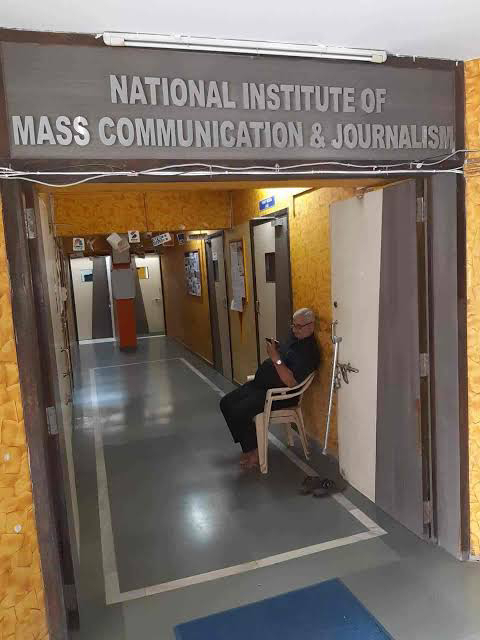
Only 25% of mass communication students become journalists, even they are unstable

I have never studied in a journalism school, though I find that today only those who graduate (or post-graduate) in what is now termed as mass communication are taken as journalists in all top papers and other news outfits. In fact, there is no separate journalism course today.
So what are produced in what is called mass communication courses? "Journalism is just one subject out of many in the mass communication course", I was told by one of the senior teachers -- a professor -- in a private university at a workshop organised by Google News in Ahmedabad. So what does the course teach? And what kind of professionals does it produce?
This is what I learned: only 25% of the students are interested in going to journalism, while others would like to pursue their communication skills as public relations person, or work in advertising industry, or elsewhere where you require communication expertise. Surely, journalism is no more a lucrative choice. 
And what are they taught? How to write and communicate in front of different media, perhaps without telling them why journalism is opposite to PR job, which requires you to sell a product or do what the corporate boss tells, while journalism requires you to tell people what the establishment does not want to reveal. 
And what happens to a student who chooses to be a journalist? She or he, after joining a news outfit, often moves over to be a PR officer or even a receptionist! This happens because they are told and taught to be always on the side of the establishment, that news flows from the established alone!
Sad state of affairs!

Comments

TRENDING

Caste, class, and Patidar agitation: Veteran academic 'unearths' Gujarat’s social history

Recently, I was talking with a veteran Gujarat-based academic who is the author of several books, including "Social Movements in India: A Review of Literature", "Untouchability in Rural India", "Public Health and Urban Development: The Study of Surat Plague", and "Dalit Identity and Politics", apart from many erudite articles and papers in research and popular journals.

Alang emerges as primary graveyard for sanctioned 'shadow fleet' tankers as legal pressure mounts

In a significant shift that appears to be reshaping the global maritime demolition landscape, oil tankers from the so-called "short fleet" — vessels operating under international sanctions — are reported to be increasingly making their final voyage to the shipbreaking yards of Alang-Sosiya in Gujarat's Bhavnagar district , industry data reveals.

From Dimagi Naxal to Kartikeya: The curious journey of a political expression

Following the Prime Minister’s “Dimagi Naxal” remark, there appears to have been a huge backlash, especially from protagonists of the “Cockroach Janata Party.” The term is being variously interpreted as a move to “isolate” dissidents, following the claim of a successful campaign against Naxalite violence. Social media is full of “Dimagi Naxal Party” memes, making a joke of an expression used, perhaps for the first time in India.