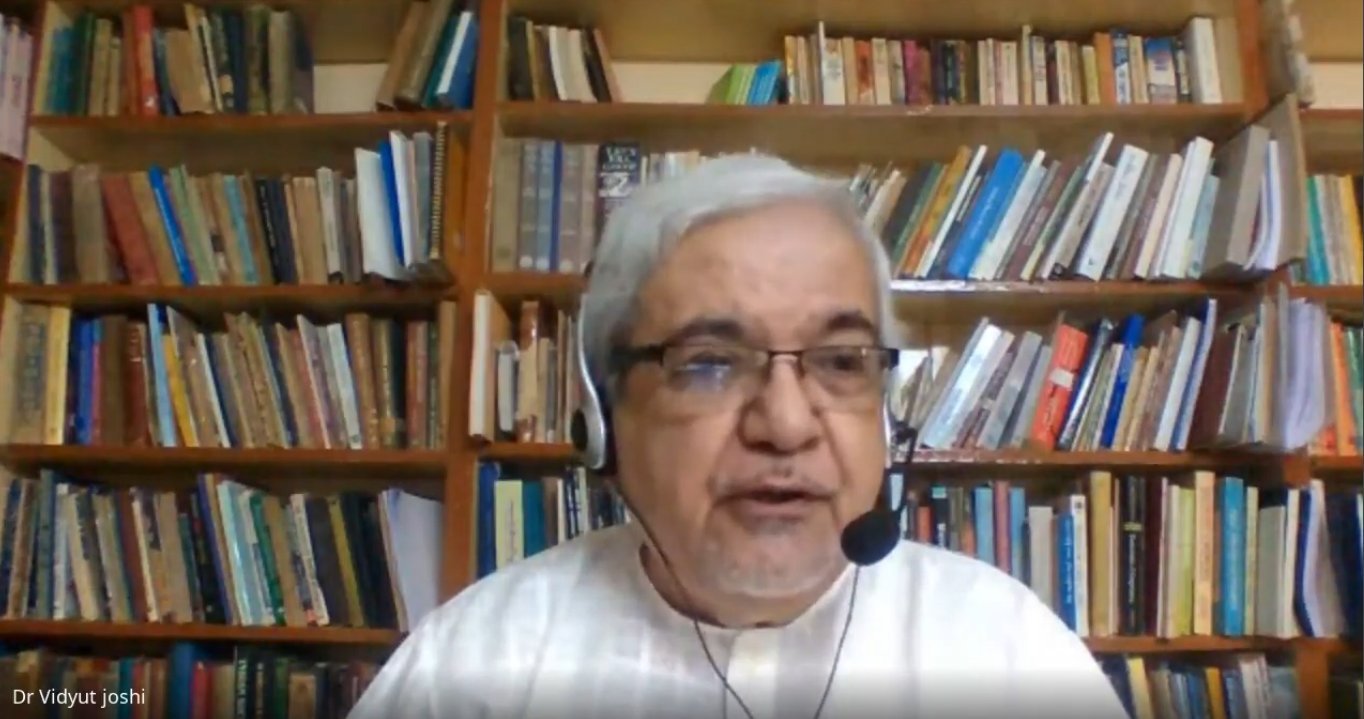
Gujarat’s knowledge institutions have lost their soul, reorientation needed: Prof. Vidyut Joshi

 
In a thought-provoking column published in Sandesh, eminent sociologist and former Vice-Chancellor Prof. Vidyut Joshi has raised urgent concerns over the erosion of intellectual autonomy and social relevance in Gujarat’s leading research and academic institutions. Building on insights from the recent paper Secret of Creating High Performing Knowledge Institutions by development economist Prof. Tushaar Shah, Joshi paints a stark picture of institutions that have strayed far from their foundational vision.
Prof. Joshi argues that many of the state’s premier research bodies—such as the Centre for Social Studies (CSS) in Surat, and the Gujarat Institute of Development Research (GIDR) and the Sardar Patel Institute of Economic and Social Research (SPIESR) in Ahmedabad—have moved from being producers of public knowledge to consultants for hire. While they were originally created as autonomous spaces for critical thinking, grounded in field-based research and societal engagement, today they are often driven by the logic of donor funding and consultancy contracts.
This transformation, Joshi asserts, has not occurred overnight. He traces a longer institutional history, pointing to how these bodies were established between the 1960s and 1980s with support from the Planning Commission and ICSSR. They were envisioned as engines of social science research that could inform public policy and deepen democratic discourse.
He credits pioneering scholars like Prof. T.D. Lakdawala, who laid the foundations of empirical economic research at SPIESR, and Prof. I.P. Desai, who grounded CSS in rigorous sociological inquiry focused on caste, community, and rural life. These figures represented an earlier generation of intellectual leadership, for whom scholarship was inseparable from social responsibility.
However, Joshi goes further back in history to show that Gujarat’s tradition of knowledge production did not begin in the post-independence era. In the 19th century, institutions like the Gujarat Vernacular Society (later Gujarat Vidya Sabha) and the Ahmedabad Education Society emerged as reformist platforms that believed knowledge should serve society. These institutions created public libraries, supported translation and publishing, and engaged with the pressing social questions of their time—be it caste reform, women’s education, or civic participation.
In contrast, Joshi laments that today’s institutions are largely inward-looking, preoccupied with funding cycles, and often isolated from both universities and the communities they were meant to serve. He observes that there is little coordination among institutions, no meaningful engagement with contemporary challenges such as informal labor, rising inequalities, or the restructuring of caste and gender in a globalized Gujarat.
Underlying this institutional crisis, Joshi suggests, is a philosophical vacuum. Where earlier scholars viewed knowledge as a means of transformation and empowerment, today’s research is often transactional, shaped by market demands rather than intellectual need. “What was once a calling has now become contract work,” he writes bluntly.
He invokes Max Weber’s idea of the “Protestant Ethic and the Spirit of Capitalism” to stress that genuine institutional performance is rooted in inner discipline, ethical vision, and commitment to the public good. Joshi calls for reimagining Gujarat’s knowledge institutions in a way that restores their intellectual autonomy and reconnects them with India’s rich civilizational and reformist traditions.
Indian epistemologies, he reminds us, always viewed knowledge (gnan) as a path to liberation—not simply a tool of employment or market utility. To revive that spirit, Joshi insists, we must go beyond technical fixes and ask fundamental questions about the role of knowledge in a democracy.
He ends with a powerful reflection: “Do our knowledge institutions still have a soul? If they cannot respond to society’s deepest questions, then what purpose do they serve?” His column, while critical, is ultimately a call to reclaim the ethical and philosophical foundations that once made Gujarat’s academic institutions respected not only nationally but also globally.

Comments

TRENDING

Disappearing schools: India's education landscape undergoing massive changes

   The other day, I received a message from education rights activist Mitra Ranjan, who claims that a whopping one lakh schools across India have been closed down or merged. This seemed unbelievable at first sight. The message from the activist, who is from the advocacy group Right to Education (RTE) Forum, states that this is happening as part of the implementation of the National Education Policy (NEP), 2020, which floated the idea of school integration/consolidation.

RTI framework ‘nuked’? SHANTI Bill triggers alarm, grants centre sweeping secrecy powers

Has the Government of India finally moved to completely change important provisions of the Right to Information (RTI) Act, that too without bringing about any amendment in the top transparency law? It would seem so, if one is to believe well known civil society leaders' keen observations on the nuclear energy Bill passed in the Lok Sabha.  Senior RTI activist Amrita Johri has sharply criticised the recently passed Sustainable Harnessing and Advancement of Nuclear Energy for Transforming India (SHANTI) Bill, 2025, saying that it has effectively “nuked” the Right to Information (RTI) Act through the back door. 

'Shameful lies': Ambedkar defamed, Godse glorified? Dalit leader vows legal battle

A few days back, I was a little surprised to receive a Hindi article in plain text format from veteran Gujarat Dalit rights leader Valjibhai Patel , known for waging many legal battles under the banner of the Council of Social Justice (CSJ) on behalf of socially oppressed communities.

A Hindu alternative to Valentine's Day? 'Shiv-Parvati was first love marriage in Universe'

The other day, I was searching on Google a quote on Maha Shivratri which I wanted to send to someone, a confirmed Shiv Bhakt, quite close to me -- with an underlying message to act positively instead of being negative. On top of the search, I chanced upon an article in, imagine!, a Nashik Corporation site which offered me something very unusual.  I don't know who owns this site, for there is nothing on it in the About Us link. It merely says, the Nashik Corporation  site   "is an educational and news website of the municipal corporation. Today, education and payment of tax are completely online." It goes on to add, "So we provide some of the latest information about Property Tax, Water Tax, Marriage Certificate, Caste Certificate, etc. So all taxpayer can get all information of their municipal in a single place.some facts about legal and financial issues that different city corporations face, but I was least interested in them."  Surely, this didn't interest...

Inside an UnMute conversation: Reflections on media, civil society and my journey

I usually avoid being interviewed. I have always believed that journalists, especially in India, are generalists who may suddenly be assigned a “beat” they know little—sometimes nothing—about. Still, when my friend  Gagan Sethi , a well-known human rights activist, phoned a few weeks ago asking if I would join a podcast on  civil society  and the media, I agreed.

When a telecom giant fails the consumer: My Airtel experience

  Initially, I was not considering writing this blog about why I found Airtel —one of India’s premier communication service providers—to have an outrageously poor sales and customer-service experience, at least in Ahmedabad , Gujarat ’s business capital. However, the last SMS I received from Airtel regarding my request for a Wi-Fi connection in my flat in the Vejalpur area left me stunned.

It is? Modi perspires four times a day to ensure face glow? But why he loved ACs?

A former Gujarat government official recently shared a tweet   by Subramaniam Swamy where a video shows Prime Minister Narendra Modi telling school children in his hometown Vadnagar that their face would glow if they perspire four times a day. He suggested his face was glowing exactly because of this reason. I have no idea whether facial glow is linked with how many times you perspire in a day, but what I know is, Modi would profusely avoid any perspiration when he was Gujarat chief minister. Thus, in 2006, Modi undertook a fast in support of the Narmada project, which he said the Centre was not supporting. The fast, it was declared, lasted for about 51 hours. I don't recall which month it was, but to avoid perspiration, he got installed air conditions in the open, just next to the spot where he and his colleagues were undertaking fast for the Narmada dam. When some enterprising journalists tried watching the ACs, they were manhandled -- for it would show his fast in poor light. S...

Top Hindu builder ties up with Muslim investor for a huge minority housing society in Ahmedabad

There is a flutter in Ahmedabad's Vejalpur area, derogatorily referred to as the "border" because, on its eastern side, there is a sprawling minority area called Juhapura, where around five lakh Muslims live. The segregation is so stark that virtually no Muslim lives in Vejalpur, populated by around four lakh Hindus, and no Hindu lives in Juhapura.

From Ahmedabad's CG Road to the Supreme Court: My brush with the stray dog menace

It was the mid-2000s when my children wanted me to take them to the municipal market on CG Road — Ahmedabad’s posh upmarket area — where they said Kentucky Fried Chicken had opened a shop. I was reluctant, but eventually had to drive them in my Maruti Frontie car from Gandhinagar , 35 kilometres away, where we lived. After finding a suitable place to park, we went in search of the high-profile restaurant. After roaming here and there, and even asking other shopkeepers in the market area, we still couldn’t find our supposed destination. So, we decided to return to our car and drive to some other place for lunch. Suddenly, a stray dog jumped on me, catching hold of my pant. While I managed to free myself immediately — with people around shooing away the dog — I sustained a few scratches on my leg. I immediately rang up a doctor in Gandhinagar, who advised me to take an initial injection in Ahmedabad right away, which I did. I took three more shots on my return to Gandhinagar. I have ne...