
Gujarat Dalit activist sends 25 kg plastic which 'kills' cows to CM: 'Punish the guilty'

 
By Rajiv Shah 
Gujarat's grassroots Dalit rights activist Natubhai Parmar -- who created a flutter by dumping a tractor full of dead cows in front of Surendranagar district office in 2016 following cow vigilantes beating up Dalits belonging to the Rohit community in Una on July 11, 2016 on suspicion of cow slaughter -- has stunned the state administration yet again. Now he has sent across 25 kg of plastic recovered from the womb of a cow to Gujarat chief minister Vijay Rupani to tell him: Plastics are the main cause of cow slaughter.
The cow vigilantes tied up four Dalit boys on an SUV with a chain, and paraded them for about a kilometre up to a local police station, caning them up all the way. The boys were beaten up on suspicion cow slaughter, even as their plea that they were skinning a dead cow, their hereditary occupation, was ignored. After a video went viral showing the incident, protests broken out across Gujarat, with Rohits pledging they would not skin cows any more.
Parmar, an activist with Navsarjan Trust, Gujarat's biggest Dalit rights organization, took this opportunity to tell the administration that Rohits were being forced to do this caste-based occupation, of skinning cows, and would not do it any more because of repeated harassment by the administration and vigilantes, which blamed them for slaughtering cows.
The cow protection exhibition 
A year ago, on May 10, 2017, Parmar led a Dalit rally in Surendranagar, highlighting that cows dead because the ate plastic. A tractor carrying tens of kilos of plastic taken out of dead cows' womb accompanied the rally, insisting, those responsible for failing to take care of cows, setting them free as stray cattle, forcing them to eat leftovers on roadsides mixed with plastic, should be held responsible for cow slaughter.
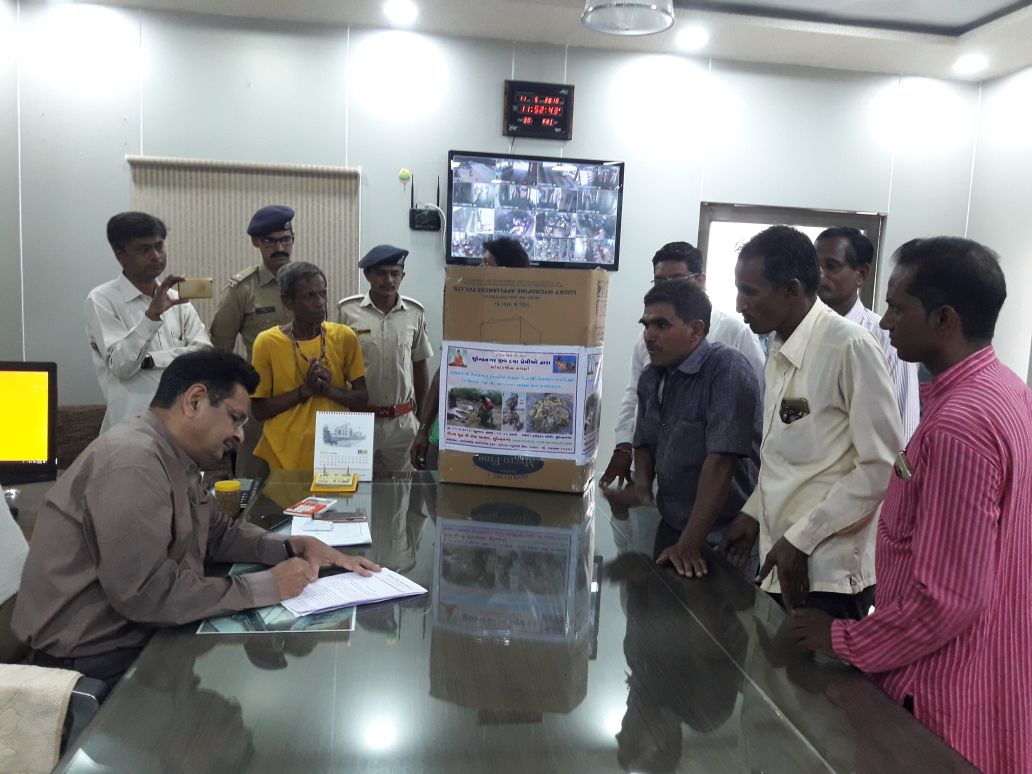
Marking the first anniversary of the rally, on Friday, Parmar organized another rally, taking a 25 kg box, plastic taken out from a dead cow after skinning the animal, to be hands over to the chief minister. The box and a memorandum addressed to the chief minister were given to the district collector, who was told, even though the government claims to revere it as a holy animal, it does not take its proper care.
He told Counterview, "I was told I wouldn't be able to hand over the plastic to the chief minister, who is visiting here for a function. So we decided to hand over this to the district collector, meant as a gift to the chief minister."
The 12-point memorandum, a copy of which he gave to Counterview, said, the main reason why cows die is because of the state policy which led to disappearance of grazing land across Gujarat. While cow sheds or panjrapols were being closed down, the existing ones do not take care of unproductive cows, hence the animal is forced to go astray, eating whatever it gets on streets, including food mixed with plastics.
Memorandum, plastic being handed over to district collector
The memorandum to the chief minister said, "The government should x-ray dead cows to find out the reason of their death. If plastic is found, the responsibility of setting the cows go astray should be fixed, and those found guilty should be tried under the the state's law which seeks to punish those slaughtering cow."
The memorandum demands taking back grazing land handed over to industrialists, setting up special fodder ration shops for cows, setting up of special veterinary hospital in each Gujarat district by operating upon live cows and taking out out plastic from their womb, a complete ban on plastics, and so on.
Parmar's move follows a unique permanent exhibition on cow protection he has organized on the road leading to Wadhvan town off Ahmedabad-Gandhidham highway. The exhibit is an installation of sorts highlighted by a cow prototype with its stomach exposed, intestines choked with plastic. At the exhibit, swathes of blood and fluid are soaked in plastic, removed by kilos from dead bovines during cow skinning, all of it hung on bamboo rods.
Comments

TRENDING

Disappearing schools: India's education landscape undergoing massive changes

   The other day, I received a message from education rights activist Mitra Ranjan, who claims that a whopping one lakh schools across India have been closed down or merged. This seemed unbelievable at first sight. The message from the activist, who is from the advocacy group Right to Education (RTE) Forum, states that this is happening as part of the implementation of the National Education Policy (NEP), 2020, which floated the idea of school integration/consolidation.

A Hindu alternative to Valentine's Day? 'Shiv-Parvati was first love marriage in Universe'

The other day, I was searching on Google a quote on Maha Shivratri which I wanted to send to someone, a confirmed Shiv Bhakt, quite close to me -- with an underlying message to act positively instead of being negative. On top of the search, I chanced upon an article in, imagine!, a Nashik Corporation site which offered me something very unusual.  I don't know who owns this site, for there is nothing on it in the About Us link. It merely says, the Nashik Corporation  site   "is an educational and news website of the municipal corporation. Today, education and payment of tax are completely online." It goes on to add, "So we provide some of the latest information about Property Tax, Water Tax, Marriage Certificate, Caste Certificate, etc. So all taxpayer can get all information of their municipal in a single place.some facts about legal and financial issues that different city corporations face, but I was least interested in them."  Surely, this didn't interest...

Did Bank of India send a fake SMS, or is its website under attack?

On the evening of February 14, after banking hours, I received a strange SMS from Bank of India (BOI)—where I maintain a very small, largely inactive account. I had opened it years ago simply because a branch was located near my home. However, finding their services quite poor, I rarely use it anymore.

A story Gujarat forgot: Dalits and the Dakor temple movement

The other day, I was talking with Martin Macwan, a well-known Gujarat Dalit rights leader. He revealed to me an interesting chapter of the Gandhian movement in Gujarat — how Ravishankar Maharaj (1884–1984), a prominent Gandhian social reformer of the state, played a pivotal role in the struggle for temple entry for Dalits (then referred to as Harijans) in the late 1940s.

Varnashram Dharma: How Gandhi's views evolved, moved closer to Ambedkar's

  My interaction with critics and supporters of Mahatma Gandhi, ranging from those who consider themselves diehard Gandhians to Left-wing and Dalit intellectuals, has revealed that in the long arc of his public life, few issues expose his philosophical tensions more than his shifting stance on Varnashram Dharma—the ancient Hindu concept that society should be divided into four varnas, or classes, based on duties and aptitudes.

Caste, class, and Patidar agitation: Veteran academic 'unearths' Gujarat’s social history

Recently, I was talking with a veteran Gujarat-based academic who is the author of several books, including "Social Movements in India: A Review of Literature", "Untouchability in Rural India", "Public Health and Urban Development: The Study of Surat Plague", and "Dalit Identity and Politics", apart from many erudite articles and papers in research and popular journals.

Remembering R.K. Misra: A 'news plumber' who refused to compromise

It is always sad when a journalist colleague passes away — more so when that person has remained firm in his journalistic moorings. Compared to many others, I did not know R.K. Misra, who passed away on February 23 after a long illness, very intimately, but we interacted occasionally over the years.

Top Hindu builder ties up with Muslim investor for a huge minority housing society in Ahmedabad

There is a flutter in Ahmedabad's Vejalpur area, derogatorily referred to as the "border" because, on its eastern side, there is a sprawling minority area called Juhapura, where around five lakh Muslims live. The segregation is so stark that virtually no Muslim lives in Vejalpur, populated by around four lakh Hindus, and no Hindu lives in Juhapura.

Punishing senior citizens? Flipkart, Shopsy stop Cash on Delivery in Ahmedabad!

The other day, someone close to me attempted to order some goodies on Flipkart and its subsidiary Shopsy. After preparing a long list of items, this person, as usual, opted for the Cash on Delivery (popularly known as COD) option, as this senior citizen isn't very familiar with online prepaid payment methods like UPI, credit or debit cards, or online bank transfers through websites. In fact, she is hesitant to make online payments, fearing, "I may make a mistake," she explained, adding, "I read a lot about online frauds, so I always choose COD as it's safe. I have no knowledge of how to prepay online."