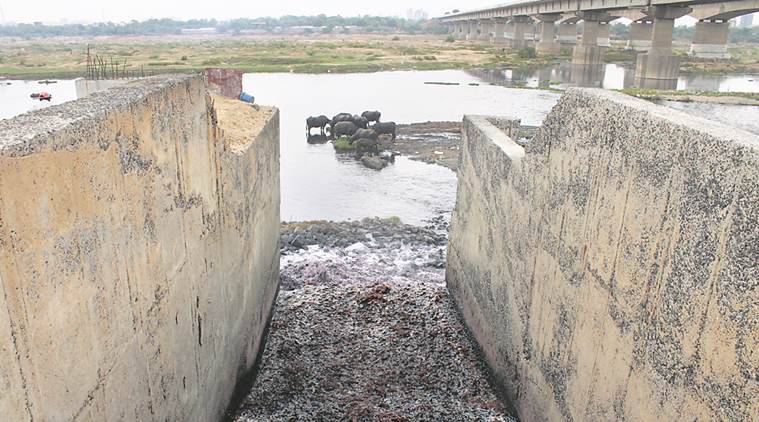
In a surprise admission, the Ahmedabad Municipal Commission (AMC) has said that “ill-treated or untreated or partly treated” industrial waste from “improperly working” effluent treatment plants (ETPs) is being “discharged into Sabarmati directly”. It added in an affidavit filed in the Gujarat High Court (HC) that “completely untreated industrial discharge” is also being “illegally discharged into the sewerage network” designed for household sewage.
It further admitted, there has been “illegal industrial discharge into sewerage access points such as manholes or machine-holes at odd hours (such as, in the middle of the night) by using tankers and flexible pipes.” Worse, there is “reverse boring of industrial discharge or usage of defunct/unused bore-wells or percolation wells to discharge industrial waste directly into the ground”, it added.The AMC admission comes amidst as one of the members of the High Court-appointed task force, environmentalist Rohit Prajapati, telling the court during a recent hearing that Sabarmati for the 120 kilometres stretch in the downstream right up to the Arabian Sea is a “dead river.”
Briefing the court on proceedings of the meeting of the task force – formed on September 14, 2021 following a writ petition in the High Court on pollution in Sabarmati river – Prajapati said, all of its members had agreed that while the stretch of the Sabarmati river in the Ahmedabad city within the Riverfront Project was “brimming with stagnant water”, the stretch of “120 km of the river, before meeting the Arabian Sea, is ‘dead’.”
Insisting that the 120 km stretch “comprises of partially treated industrial effluent and sewage”, he said, “The Sabarmati river is highly polluted/contaminated… When the discharge quality deteriorates, the water quality in the river including its ecosystem would also deteriorate.”
Insisting that “there should be no discharge of the untreated industrial effluents and the sewage into the Sabarmati river”, he said, the Gujarat Pollution Control Board (GPCB) should act against the defaulting association running/handling the Common Effluent Treatment Plants (CETPs) and its member industries”, while AMC, “which is responsible for running the sewage treatment plants should ensure that the norms prescribed by GPCB .. are complied with scrupulously.”
He emphasised on the need to go ahead with “criminal prosecutions” against “all the owners/directors of the defaulting polluting industries, officers of the CETPs and the municipal commissioner of the Ahmedabad city if they are unable to adhere to the prescribed norms.”
Pointing out that the task force would further investigate and prepare “detailed reports about the ground water contamination as well as the contamination of the soil, food grains, vegetables and fodder for the 120 km downstream Sabarmati river”, he suggested, the environmental compensation for the damage caused by such erring entities must be recovered under as per the “formula prescribed” (polluter pay) by orders of the National Green Tribunal and the Supreme Court.
Prajapati said, the task force members “unanimously agreed” that the stretch of the Sabarmati river from Hansol to Vautha (120 km stretch) would be taken up “on priority basis” by making site visits by the second week of October 2021. Meanwhile, AMC should initiate “extensive drive” to identify the industries discharging the effluent into the sewerage network without permission, and initiate appropriate action.
It was also agreed that the traffic police should “increase surveillance on tankers or tractors carrying on hazardous waste and chemical effluent from the nearby industrial areas and to keep a strong vigil/check on any illegal discharge into the Sabarmati river and the drains”, he said.
He added, “It was discussed that no industry engaged in the manufacturing or dealing with the hazardous chemicals, acids, solvents, etc. should be permitted to discharge into the municipal sewer” and that “any such permission given in the past by GPCB or AMC should be “immediately withdrawn”.
Agreeing that ETPs and CETPs are not functioning as required, GPCB in its affidavit gave specific examples of these are being run in AMC-controlled areas Danilimda and Behrampura, which have 257 and 285 units respectively. It said, the Karnavati Textile Association, which was granted permission for setting up 130 MLD CETP, the same has till date not yet commenced the work.”
Based on the information provided by the task force, AMC and GPCB, the High Court bench consisting of Justices JB Pardiwala and Vaibhari D Nanavati directed the authorities concerned to “disconnect” water drainage and electricity of erring industrial units “which release partially treated/untreated wastewater”, insisting, no reconnection should be granted without GPCB “prior approval.”
As for the joint task force, the bench empowered it not only continue its work but also “publish in the newspapers the details of the set-up/industry along with the name of the owner running such set-up guilty of releasing untreated effluent wastewater into the sewer line maintained by AMC.”
 |
| Rohit Prajapati |
It was also agreed that the traffic police should “increase surveillance on tankers or tractors carrying on hazardous waste and chemical effluent from the nearby industrial areas and to keep a strong vigil/check on any illegal discharge into the Sabarmati river and the drains”, he said.
He added, “It was discussed that no industry engaged in the manufacturing or dealing with the hazardous chemicals, acids, solvents, etc. should be permitted to discharge into the municipal sewer” and that “any such permission given in the past by GPCB or AMC should be “immediately withdrawn”.
Agreeing that ETPs and CETPs are not functioning as required, GPCB in its affidavit gave specific examples of these are being run in AMC-controlled areas Danilimda and Behrampura, which have 257 and 285 units respectively. It said, the Karnavati Textile Association, which was granted permission for setting up 130 MLD CETP, the same has till date not yet commenced the work.”
Based on the information provided by the task force, AMC and GPCB, the High Court bench consisting of Justices JB Pardiwala and Vaibhari D Nanavati directed the authorities concerned to “disconnect” water drainage and electricity of erring industrial units “which release partially treated/untreated wastewater”, insisting, no reconnection should be granted without GPCB “prior approval.”
As for the joint task force, the bench empowered it not only continue its work but also “publish in the newspapers the details of the set-up/industry along with the name of the owner running such set-up guilty of releasing untreated effluent wastewater into the sewer line maintained by AMC.”
Comments