
Neoliberal growth in Gujarat has 'intensified social and economic inequalities'

 A just-released report, “Reducing Inequality: Learning Lessons for the Post-1015 Agenda. India Case Study”, by Save the Children has regretted that “the rapid economic growth that Gujarat has experienced over the past decade has been of the nature of exclusionary growth where goals like social equality, sustainable livelihoods, access to education and health, justice and peace have been abandoned in the race for high-speed growth.”
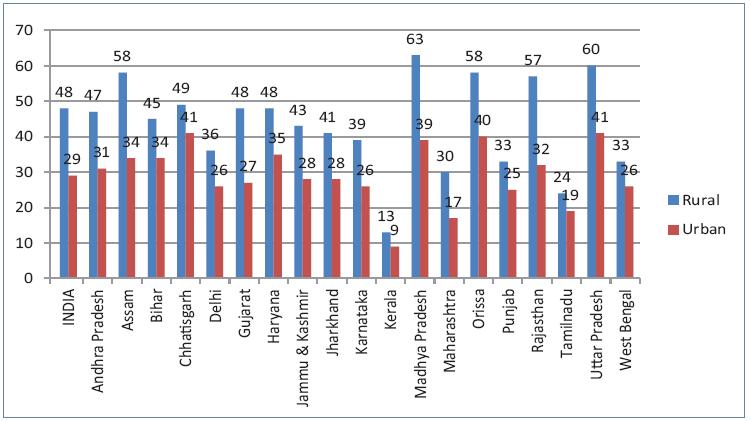
The report, by the world’s leading independent organization that works to inspire breakthroughs in the way the world treats children to achieve immediate and lasting change in their lives, states that Gujarat's “expenditure in social sectors, both as a percentage of GSDP and as a percentage of total expenditure, has declined more than the average decline in other comparable States and stands below the national average pointing to a clear shift in the priorities.”
Infant mortality rate among states

The report observes, “There is a decline in the usage of government health services in both rural and urban areas of Gujarat and a very high reliance on the private sector. In urban areas, the decline has been quite significant for the lowest income group.”
It adds, “Data for some select states of IMR for 2010 (based on availability) reveal that across all states and across regions, the IMR for females are relatively higher. This is a clear reflection of the gender bias that exists in India even today. The Western states of Gujarat and Rajasthan and Northern state of Uttar Pradesh show higher differences than the other states.”
Hunger Index among states

The report has been prepared to study rising inequality, which it says has “emerged as one of the most important problems confronting societies across the world.” It underlines, “Within the Asian region, South Asia has experienced rapid increases in income/ consumption inequality during the recent period of its rapid growth. This is quite evident in case of India, the largest economy in the region with over a billion people. There is evidence to suggest that the poorer sections of India were actually further marginalised under the neoliberal economic regime introduced in India in the early 1990s.”
Calorie intake per capita among states
Singling out Gujarat in this context, the report states, “Poorer states like Bihar, Uttar Pradesh and Orissa witnessed only a marginal improvement in terms of per capita NSDP (Net State Domestic Product), whereas the richer states like Gujarat, Maharashtra, etc witnessed substantial rises.”
This has not helped reduce inequalities, it underlines: “States that witnessed greater rise in per capita NSDP during the period 1993- 94 to 2004-05 also witnessed higher rise in state-level Gini coefficients. This implies that the states that experienced more ‘growth’ actually had worsening inequalities.”
The report further says, “Within States, the rural-urban divide worsened. Urban consumption levels were double that of rural consumption levels. The social factor of caste plays a major role in determining household Monthly Per Capita Expenditure (MPCE) levels. The Social Category “Others” had higher MPCEs across both rural and urban sectors in India compared to the other categories, viz. the Scheduled Castes (SC), Scheduled Tribes (ST) and Other backward Classes (OBC).”
The report points towards how “the systematic withdrawal of the state from social welfare activities has undermined the previous progress towards universal access and has resulted in increased inequality and exclusion.” In this context, it believes, “Per capita NSDP does not capture the actual distribution amongst the population as it assumes equal shares for all.”
Life expectancy among states
The report underlines, “The easiest method of measuring actual distribution is by analysing differences in consumption expenditures, as given by the National Sample Survey Organization (NSSO) periodic sample survey reporting.” Even its “household consumption data tend to understate the extent of inequality by underestimating the tails of the distribution (excluding the very rich and the very poor) and because the poor are more likely to consume as much or even more than their income while the rich are more able to save.”
Coming to calorie intake as the criterion of health, the study says, “In the rural sector, Punjab has the highest per capita calorie intake of 2223 Cal while Jharkhand had the lowest of 1900 Cal. It is interesting to note that some of the poorer states like Orissa and Uttar Pradesh had  alorie intakes higher than the national average while comparatively richer states like Gujarat and Tamil Nadu had lower than the national average rate of calorie intake.”
Emphasising that “a significant dimension of health is life expectancy, which has been increasing over the years”, the study says, “It has increased more for females than males. According to 2002-06 estimates, life expectancy at birth for males was 62.6 years as compared to 64.2 years for females. Also the urban male (67.1 years) and urban female (70 years) have longer life spans as compared to their rural counterparts (61.2 and 62.7 years respectively).”
Maternal mortality rate among states
As for Gujarat, it reminds again that it “has one of the highest per capita incomes of all major states (per capita net state domestic product (NSDP) at constant (2004-05) prices of Rs 52,708 in 2010-11)”, but “has only been a moderate performer in this regard. Gujarat’s IMR in 2011 is close to that of much poorer and less developed Bihar despite the much higher per capita income in that state (per capita NSDP of Bihar in 2010-11 is Rs.13,632).”
It says, “Kerala has shown one of the lowest infant mortality rates historically. Its IMR has been many times less than the Indian average. Kerala’s performance is more creditable than any other states as it has managed to reduce the already low IMR even further over the period.”
It adds, “It is surprising to note that even urban IMR is high in the states of Delhi and Gujarat...The relatively richer states of Gujarat and Haryana have shown slower improvements in lowering IMR. incomes of all major states.”
Crude birth rate among states
As for the maternal mortality rate (MMR), the report says, “Gujarat again has proved to be a poor performer as the MMR has actually gone up in Gujarat over the period 1997-98 to 2007-09 recording a negative rate of decline.” It is in the company of “states of the north western region Uttar Pradesh, Rajasthan and Bihar, which still show quite high rates of maternal mortality.
As for education, “while states such as Tamil Nadu, Sikkim, Mizoram, Arunachal Pradesh, and Manipur spent 10.2 per cent, 9.8 per cent, 9.1 per cent, 7.1 per cent, and 6.4 per cent, respectively, of their total state domestic product (SDP) on education in 2007-08, there were several states (e.g. Maharashtra, Delhi, Gujarat, Haryana, Punjab, Andhra Pradesh, Goa) which spent less than 2 per cent of their SDP on education.”
Even on increase in pupil-teacher ratio (PTR), the report says, “In 2009-10, number of districts where PTR was above 30 has increased to 304 during 2009-10 compared to 284 in 2008-09. These districts are mainly concentrated in Bihar, Gujarat, Jharkhand, Madhya Pradesh, Orissa, Uttar Pradesh and West Bengal.”

Comments

TRENDING

Disappearing schools: India's education landscape undergoing massive changes

   The other day, I received a message from education rights activist Mitra Ranjan, who claims that a whopping one lakh schools across India have been closed down or merged. This seemed unbelievable at first sight. The message from the activist, who is from the advocacy group Right to Education (RTE) Forum, states that this is happening as part of the implementation of the National Education Policy (NEP), 2020, which floated the idea of school integration/consolidation.

'Shameful lies': Ambedkar defamed, Godse glorified? Dalit leader vows legal battle

A few days back, I was a little surprised to receive a Hindi article in plain text format from veteran Gujarat Dalit rights leader Valjibhai Patel , known for waging many legal battles under the banner of the Council of Social Justice (CSJ) on behalf of socially oppressed communities.

A Hindu alternative to Valentine's Day? 'Shiv-Parvati was first love marriage in Universe'

The other day, I was searching on Google a quote on Maha Shivratri which I wanted to send to someone, a confirmed Shiv Bhakt, quite close to me -- with an underlying message to act positively instead of being negative. On top of the search, I chanced upon an article in, imagine!, a Nashik Corporation site which offered me something very unusual.  I don't know who owns this site, for there is nothing on it in the About Us link. It merely says, the Nashik Corporation  site   "is an educational and news website of the municipal corporation. Today, education and payment of tax are completely online." It goes on to add, "So we provide some of the latest information about Property Tax, Water Tax, Marriage Certificate, Caste Certificate, etc. So all taxpayer can get all information of their municipal in a single place.some facts about legal and financial issues that different city corporations face, but I was least interested in them."  Surely, this didn't interest...

Inside an UnMute conversation: Reflections on media, civil society and my journey

I usually avoid being interviewed. I have always believed that journalists, especially in India, are generalists who may suddenly be assigned a “beat” they know little—sometimes nothing—about. Still, when my friend  Gagan Sethi , a well-known human rights activist, phoned a few weeks ago asking if I would join a podcast on  civil society  and the media, I agreed.

Overworked and threatened: Teachers caught in Gujarat’s electoral roll revision drive

I have in my hand a representation addressed to the Chief Electoral Officer (CEO), Gujarat, urging the Election Commission of India (ECI) to stop “atrocities on teachers and education in the name of election work.” The representation, submitted by Dr. Kanubhai Khadadiya of the All India Save Education Committee (AISEC), Gujarat chapter -- its contents matched  what a couple of teachers serving as Block Level Officers (BLOs) told me a couple of days esrlier during a recent visit to a close acquaintance.

Whither GIFT City push? Housing supply soars in Mumbai, Hyderabad, Pune, not Ahmedabad

A  new report  by a firm describing itself as a "digital real estate transaction and advisory platform,"  Proptiger , states that the Mumbai Metropolitan Region (MMR) has been the largest contributor to housing units among India's top eight cities currently experiencing a real estate boom. Accounting for 26.9% of all new launches, it is followed by  Pune  with 18.7% and  Hyderabad  with 13.6%. These three cities collectively represented 59.2% of the new inventory introduced during the third quarter (July to September 2025), which is the focus of the report’s analysis. 

The tribal woman who carried freedom in her songs... and my family’s secret in her memory

It was a pleasant surprise to come across a short yet crisp article by the well-known Gujarat-based scholar Gaurang Jani , former head of the Sociology Department at Gujarat University , on a remarkable grand old lady of Vedcchi Ashram —an educational institute founded by Mahatma Gandhi in South Gujarat in the early years of the freedom movement.

India’s expanding coal-to-chemical push raises concerns amidst global exit call

  As the world prepares for  COP30  in  Belém , a new global report has raised serious alarms about the continued expansion of coal-based industries, particularly in India and China. The 2025  Global Coal Exit List  (GCEL), released by Germany-based NGO  Urgewald  and 48 partners, reveals a worrying rise in  coal-to-chemical projects  and  captive power plants  despite mounting evidence of climate risks and tightening international finance restrictions.

Varnashram Dharma: How Gandhi's views evolved, moved closer to Ambedkar's

  My interaction with critics and supporters of Mahatma Gandhi, ranging from those who consider themselves diehard Gandhians to Left-wing and Dalit intellectuals, has revealed that in the long arc of his public life, few issues expose his philosophical tensions more than his shifting stance on Varnashram Dharma—the ancient Hindu concept that society should be divided into four varnas, or classes, based on duties and aptitudes.