
Rajasthan cops 'halt' Gujarat Dalit women's rally: homage to untouchability victim boy

 
In a surprise move, the Rajasthan police stopped a Dalit women's rally from Gujarat on the borders after it crossed Gujarat alleging that it would "disturb peace" in village Surana, Jalore district, where the gruesome incident of death of a Dalit boy took place on August 13 after he was brutally beaten up by his teacher on touching the drinking water pot.
Sources said, while the Gujarat government had "no objection" in allowing the rally, which originated from the Dalit Shakti Kendra (DSK), an empowerment-cut-technical institute for teens founded by human rights leader Martin Macwan, on September 24 morning, the Rajasthan police stopped it for two and a half hours before allowing it to proceed to Surana.
The decision to take out a women's rally was taken at a DSK meeting on September 5 following a condolence meeting of the NGO Navsarjan Trust, also founded by Macwan, activists committed to work against caste-based discrimination, organised to offer condolences to Dalit boy Indra Kumar Meghwal.
Claimed an NGO communique, simultaneous condolences were held in 1508 villages of 12 states of India, where people also donated Rs 2,77,229 to support the parents of the Dalit. The condolence meetings also discussed the "brutal mindset of teachers discriminating Dalit students in the school, and instead of building a strong nation, they are segregating children based on caste", the NGO said.
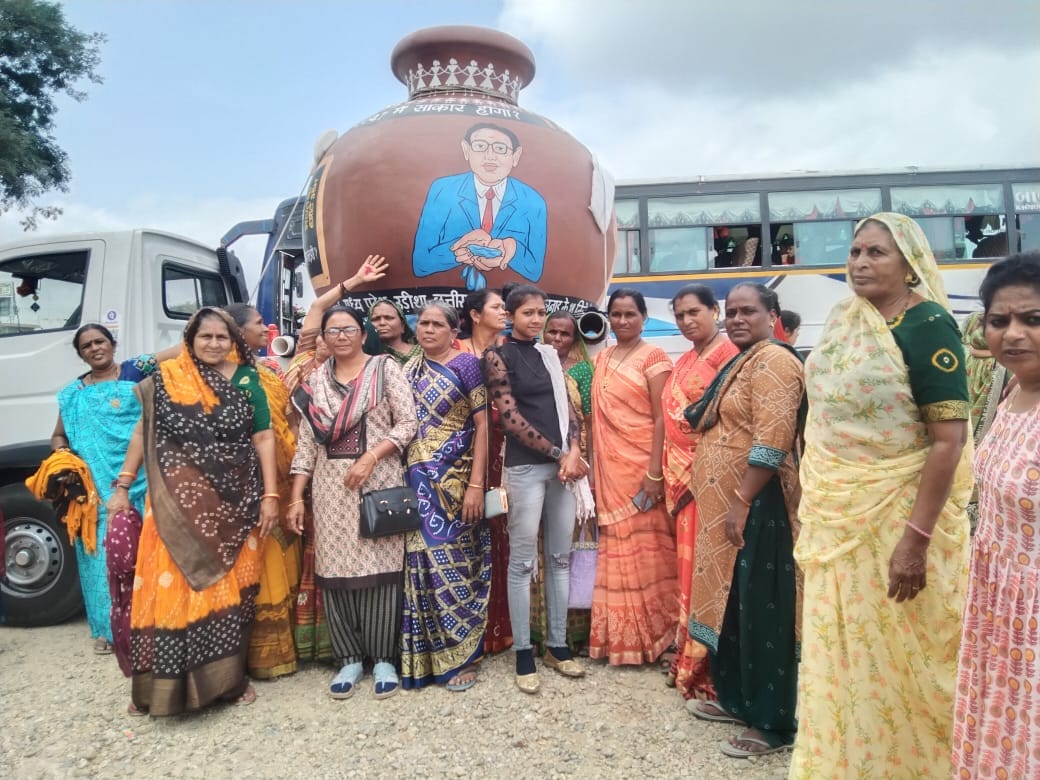
According to the NGO, the rally, which consisted of just 275 women, was held on September 24, which also happens to be the 90th anniversary of the Poona Pact, where Mahatma Gandhi promised an untouchability free India to Dr BR Ambedkar. In exchange, Ambedkar gave up his demand for separate electorate for the Dalits.
The 275 women were stopped by Rajasthan police near Raniwara village on the border of Gujarat and Rajasthan. They carried with them a 7 feet pot having the public donation of Rs 2,77,229 to the parents of Meghwal. All 275 women sat on a dharna on the road against the act of police and "for violating the fundamental right of peaceful protest."
The 7 feet tall drinking water pot was especially built with the painted images of Indra Kumar Megwal and Ambedkar, who took water from Chavdar lake of Mahad as a mark of symbolic protest against untouchability. "The pot was finally allowed be kept in the old village house of the Dalit boy as a memorial, and also to understand the reality of Dalit children", the source said.

Comments

TRENDING

A Hindu alternative to Valentine's Day? 'Shiv-Parvati was first love marriage in Universe'

The other day, I was searching on Google a quote on Maha Shivratri which I wanted to send to someone, a confirmed Shiv Bhakt, quite close to me -- with an underlying message to act positively instead of being negative. On top of the search, I chanced upon an article in, imagine!, a Nashik Corporation site which offered me something very unusual.  I don't know who owns this site, for there is nothing on it in the About Us link. It merely says, the Nashik Corporation  site   "is an educational and news website of the municipal corporation. Today, education and payment of tax are completely online." It goes on to add, "So we provide some of the latest information about Property Tax, Water Tax, Marriage Certificate, Caste Certificate, etc. So all taxpayer can get all information of their municipal in a single place.some facts about legal and financial issues that different city corporations face, but I was least interested in them."  Surely, this didn't interest...

Beyond the 'plum' posting: Why the caste lens still defines bureaucratic success

Following my recent blog on former IAS bureaucrat Atanu Chakraborty’s sudden exit as non-executive chairman of HDFC Bank, a few colleagues from the Gujarat cadre — mostly those I interacted with during my Gandhinagar stint (1997–2012) as the Times of India representative — reacted rather sharply. Most of them sent their responses directly on WhatsApp, touching upon on the merits and demerits of Chakraborty’s controversial move. One former IAS officer, a Dalit, however, went further, raising a broader question: why do some officials like Chakraborty secure plum post-retirement assignments, while others are overlooked?

Blaming RTE, not underfunding: Education groups hit back at NITI Aayog working paper

A preliminary working paper by Arvind Virmani, economist and member of the Government of India think tank NITI Aayog, has concluded that the Right to Education (RTE) Act — enacted to guarantee free and compulsory schooling for children between six and fourteen — has actually worsened learning outcomes rather than improved them. The paper, published in March 2026 and reported by The Print on 16 April, has drawn sharp pushback from education rights advocates, who argue it builds a politically motivated narrative against constitutionally guaranteed entitlements.