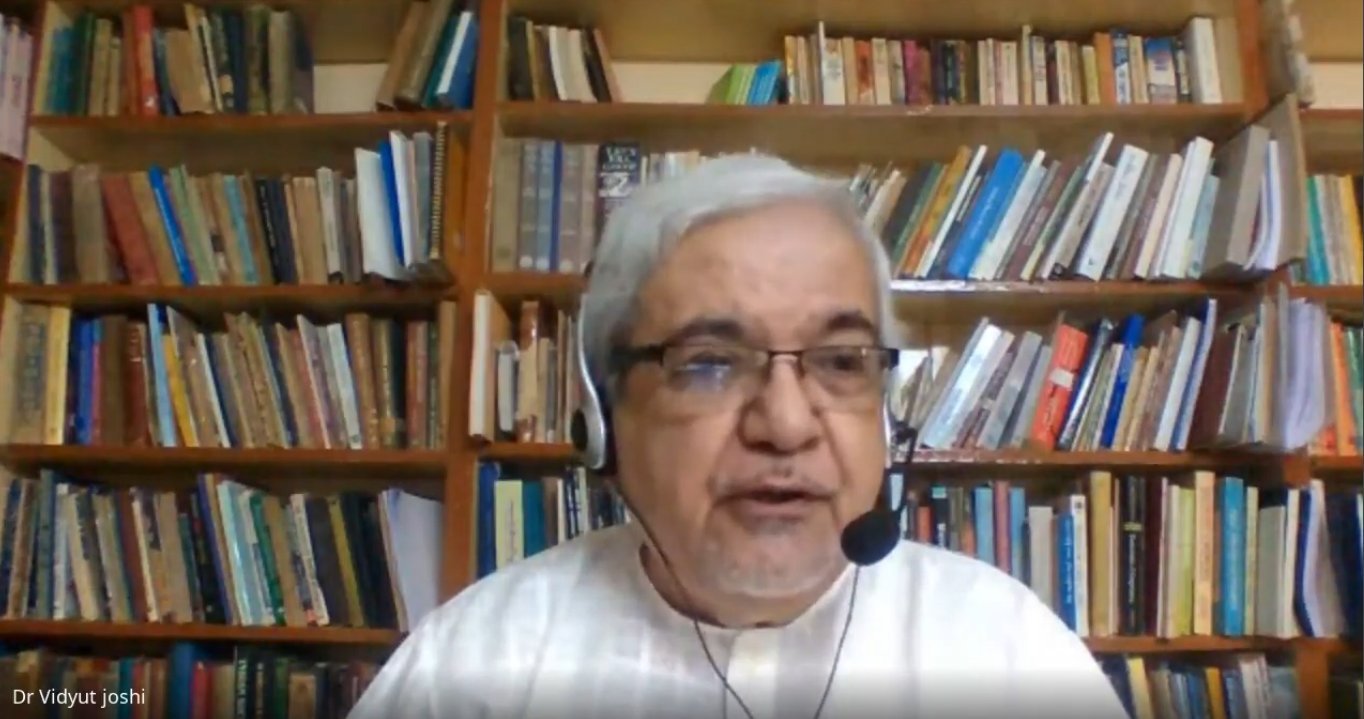
Gujarat’s knowledge institutions have lost their soul, reorientation needed: Prof. Vidyut Joshi

 
In a thought-provoking column published in Sandesh, eminent sociologist and former Vice-Chancellor Prof. Vidyut Joshi has raised urgent concerns over the erosion of intellectual autonomy and social relevance in Gujarat’s leading research and academic institutions. Building on insights from the recent paper Secret of Creating High Performing Knowledge Institutions by development economist Prof. Tushaar Shah, Joshi paints a stark picture of institutions that have strayed far from their foundational vision.
Prof. Joshi argues that many of the state’s premier research bodies—such as the Centre for Social Studies (CSS) in Surat, and the Gujarat Institute of Development Research (GIDR) and the Sardar Patel Institute of Economic and Social Research (SPIESR) in Ahmedabad—have moved from being producers of public knowledge to consultants for hire. While they were originally created as autonomous spaces for critical thinking, grounded in field-based research and societal engagement, today they are often driven by the logic of donor funding and consultancy contracts.
This transformation, Joshi asserts, has not occurred overnight. He traces a longer institutional history, pointing to how these bodies were established between the 1960s and 1980s with support from the Planning Commission and ICSSR. They were envisioned as engines of social science research that could inform public policy and deepen democratic discourse.
He credits pioneering scholars like Prof. T.D. Lakdawala, who laid the foundations of empirical economic research at SPIESR, and Prof. I.P. Desai, who grounded CSS in rigorous sociological inquiry focused on caste, community, and rural life. These figures represented an earlier generation of intellectual leadership, for whom scholarship was inseparable from social responsibility.
However, Joshi goes further back in history to show that Gujarat’s tradition of knowledge production did not begin in the post-independence era. In the 19th century, institutions like the Gujarat Vernacular Society (later Gujarat Vidya Sabha) and the Ahmedabad Education Society emerged as reformist platforms that believed knowledge should serve society. These institutions created public libraries, supported translation and publishing, and engaged with the pressing social questions of their time—be it caste reform, women’s education, or civic participation.
In contrast, Joshi laments that today’s institutions are largely inward-looking, preoccupied with funding cycles, and often isolated from both universities and the communities they were meant to serve. He observes that there is little coordination among institutions, no meaningful engagement with contemporary challenges such as informal labor, rising inequalities, or the restructuring of caste and gender in a globalized Gujarat.
Underlying this institutional crisis, Joshi suggests, is a philosophical vacuum. Where earlier scholars viewed knowledge as a means of transformation and empowerment, today’s research is often transactional, shaped by market demands rather than intellectual need. “What was once a calling has now become contract work,” he writes bluntly.
He invokes Max Weber’s idea of the “Protestant Ethic and the Spirit of Capitalism” to stress that genuine institutional performance is rooted in inner discipline, ethical vision, and commitment to the public good. Joshi calls for reimagining Gujarat’s knowledge institutions in a way that restores their intellectual autonomy and reconnects them with India’s rich civilizational and reformist traditions.
Indian epistemologies, he reminds us, always viewed knowledge (gnan) as a path to liberation—not simply a tool of employment or market utility. To revive that spirit, Joshi insists, we must go beyond technical fixes and ask fundamental questions about the role of knowledge in a democracy.
He ends with a powerful reflection: “Do our knowledge institutions still have a soul? If they cannot respond to society’s deepest questions, then what purpose do they serve?” His column, while critical, is ultimately a call to reclaim the ethical and philosophical foundations that once made Gujarat’s academic institutions respected not only nationally but also globally.

Comments

TRENDING

Disappearing schools: India's education landscape undergoing massive changes

   The other day, I received a message from education rights activist Mitra Ranjan, who claims that a whopping one lakh schools across India have been closed down or merged. This seemed unbelievable at first sight. The message from the activist, who is from the advocacy group Right to Education (RTE) Forum, states that this is happening as part of the implementation of the National Education Policy (NEP), 2020, which floated the idea of school integration/consolidation.

'Shameful lies': Ambedkar defamed, Godse glorified? Dalit leader vows legal battle

A few days back, I was a little surprised to receive a Hindi article in plain text format from veteran Gujarat Dalit rights leader Valjibhai Patel , known for waging many legal battles under the banner of the Council of Social Justice (CSJ) on behalf of socially oppressed communities.

Inside an UnMute conversation: Reflections on media, civil society and my journey

I usually avoid being interviewed. I have always believed that journalists, especially in India, are generalists who may suddenly be assigned a “beat” they know little—sometimes nothing—about. Still, when my friend  Gagan Sethi , a well-known human rights activist, phoned a few weeks ago asking if I would join a podcast on  civil society  and the media, I agreed.

A Hindu alternative to Valentine's Day? 'Shiv-Parvati was first love marriage in Universe'

The other day, I was searching on Google a quote on Maha Shivratri which I wanted to send to someone, a confirmed Shiv Bhakt, quite close to me -- with an underlying message to act positively instead of being negative. On top of the search, I chanced upon an article in, imagine!, a Nashik Corporation site which offered me something very unusual.  I don't know who owns this site, for there is nothing on it in the About Us link. It merely says, the Nashik Corporation  site   "is an educational and news website of the municipal corporation. Today, education and payment of tax are completely online." It goes on to add, "So we provide some of the latest information about Property Tax, Water Tax, Marriage Certificate, Caste Certificate, etc. So all taxpayer can get all information of their municipal in a single place.some facts about legal and financial issues that different city corporations face, but I was least interested in them."  Surely, this didn't interest...

Overworked and threatened: Teachers caught in Gujarat’s electoral roll revision drive

I have in my hand a representation addressed to the Chief Electoral Officer (CEO), Gujarat, urging the Election Commission of India (ECI) to stop “atrocities on teachers and education in the name of election work.” The representation, submitted by Dr. Kanubhai Khadadiya of the All India Save Education Committee (AISEC), Gujarat chapter -- its contents matched  what a couple of teachers serving as Block Level Officers (BLOs) told me a couple of days esrlier during a recent visit to a close acquaintance.

Whither GIFT City push? Housing supply soars in Mumbai, Hyderabad, Pune, not Ahmedabad

A  new report  by a firm describing itself as a "digital real estate transaction and advisory platform,"  Proptiger , states that the Mumbai Metropolitan Region (MMR) has been the largest contributor to housing units among India's top eight cities currently experiencing a real estate boom. Accounting for 26.9% of all new launches, it is followed by  Pune  with 18.7% and  Hyderabad  with 13.6%. These three cities collectively represented 59.2% of the new inventory introduced during the third quarter (July to September 2025), which is the focus of the report’s analysis. 

The tribal woman who carried freedom in her songs... and my family’s secret in her memory

It was a pleasant surprise to come across a short yet crisp article by the well-known Gujarat-based scholar Gaurang Jani , former head of the Sociology Department at Gujarat University , on a remarkable grand old lady of Vedcchi Ashram —an educational institute founded by Mahatma Gandhi in South Gujarat in the early years of the freedom movement.

India’s expanding coal-to-chemical push raises concerns amidst global exit call

  As the world prepares for  COP30  in  Belém , a new global report has raised serious alarms about the continued expansion of coal-based industries, particularly in India and China. The 2025  Global Coal Exit List  (GCEL), released by Germany-based NGO  Urgewald  and 48 partners, reveals a worrying rise in  coal-to-chemical projects  and  captive power plants  despite mounting evidence of climate risks and tightening international finance restrictions.

Varnashram Dharma: How Gandhi's views evolved, moved closer to Ambedkar's

  My interaction with critics and supporters of Mahatma Gandhi, ranging from those who consider themselves diehard Gandhians to Left-wing and Dalit intellectuals, has revealed that in the long arc of his public life, few issues expose his philosophical tensions more than his shifting stance on Varnashram Dharma—the ancient Hindu concept that society should be divided into four varnas, or classes, based on duties and aptitudes.