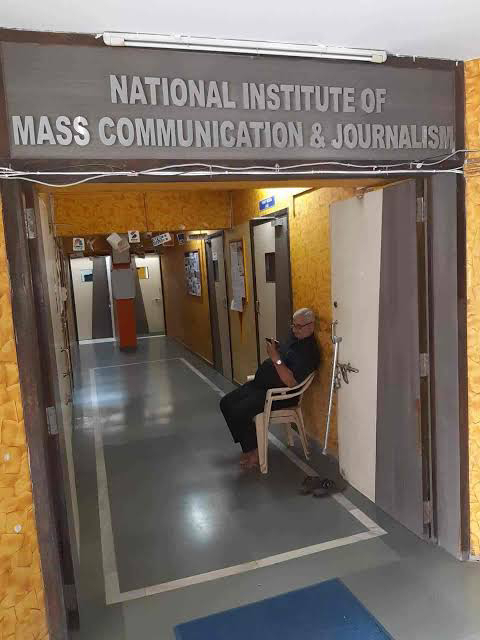
Only 25% of mass communication students become journalists, even they are unstable

I have never studied in a journalism school, though I find that today only those who graduate (or post-graduate) in what is now termed as mass communication are taken as journalists in all top papers and other news outfits. In fact, there is no separate journalism course today.
So what are produced in what is called mass communication courses? "Journalism is just one subject out of many in the mass communication course", I was told by one of the senior teachers -- a professor -- in a private university at a workshop organised by Google News in Ahmedabad. So what does the course teach? And what kind of professionals does it produce?
This is what I learned: only 25% of the students are interested in going to journalism, while others would like to pursue their communication skills as public relations person, or work in advertising industry, or elsewhere where you require communication expertise. Surely, journalism is no more a lucrative choice. 
And what are they taught? How to write and communicate in front of different media, perhaps without telling them why journalism is opposite to PR job, which requires you to sell a product or do what the corporate boss tells, while journalism requires you to tell people what the establishment does not want to reveal. 
And what happens to a student who chooses to be a journalist? She or he, after joining a news outfit, often moves over to be a PR officer or even a receptionist! This happens because they are told and taught to be always on the side of the establishment, that news flows from the established alone!
Sad state of affairs!

Comments

TRENDING

A Hindu alternative to Valentine's Day? 'Shiv-Parvati was first love marriage in Universe'

The other day, I was searching on Google a quote on Maha Shivratri which I wanted to send to someone, a confirmed Shiv Bhakt, quite close to me -- with an underlying message to act positively instead of being negative. On top of the search, I chanced upon an article in, imagine!, a Nashik Corporation site which offered me something very unusual.  I don't know who owns this site, for there is nothing on it in the About Us link. It merely says, the Nashik Corporation  site   "is an educational and news website of the municipal corporation. Today, education and payment of tax are completely online." It goes on to add, "So we provide some of the latest information about Property Tax, Water Tax, Marriage Certificate, Caste Certificate, etc. So all taxpayer can get all information of their municipal in a single place.some facts about legal and financial issues that different city corporations face, but I was least interested in them."  Surely, this didn't interest...

Beyond the 'plum' posting: Why the caste lens still defines bureaucratic success

Following my recent blog on former IAS bureaucrat Atanu Chakraborty’s sudden exit as non-executive chairman of HDFC Bank, a few colleagues from the Gujarat cadre — mostly those I interacted with during my Gandhinagar stint (1997–2012) as the Times of India representative — reacted rather sharply. Most of them sent their responses directly on WhatsApp, touching upon on the merits and demerits of Chakraborty’s controversial move. One former IAS officer, a Dalit, however, went further, raising a broader question: why do some officials like Chakraborty secure plum post-retirement assignments, while others are overlooked?

Blaming RTE, not underfunding: Education groups hit back at NITI Aayog working paper

A preliminary working paper by Arvind Virmani, economist and member of the Government of India think tank NITI Aayog, has concluded that the Right to Education (RTE) Act — enacted to guarantee free and compulsory schooling for children between six and fourteen — has actually worsened learning outcomes rather than improved them. The paper, published in March 2026 and reported by The Print on 16 April, has drawn sharp pushback from education rights advocates, who argue it builds a politically motivated narrative against constitutionally guaranteed entitlements.