
Vishwamitri river revival? Report urges action on pollution, flood risks, wildlife protection

   
The Vishwamitri Committee, formed by the Gujarat State Human Rights Commission, has submitted two supplementary reports on June 5, 2025, detailing efforts to rejuvenate the Vishwamitri River in Vadodara, considered Gujarat's cultural capital. The  reports  (click here and here) respond to directives from a May 26, 2025, GSHRC hearing. Comprising environmentalists, urban planners, and zoologists like Neha Sarwate, Rohit Prajapati, Dr. Ranjitsinh Devkar, Dr. Jitendra Gavali, and Mitesh Panchal, the committee focuses on mitigating pollution, stabilizing riverbanks, managing flood risks, and preserving biodiversity, particularly for crocodiles and turtles.
Between May 28 and June 3, 2025, the committee conducted site visits to assess restoration and flood management efforts. On the eastern banks, including Mangal Panday Bridge, Kalaghoda, and Akota, natural vegetation has sprouted, but invasive species dominate post-rain events. Vetiver grass planted for stabilization has failed to sprout in some areas, and debris, including municipal solid waste, persists, especially at the Akota-Dandia Bazar bridge. The committee suggested preserving healthy vegetation, removing construction debris, and converting certain areas into mini-islands using ecological engineering to enhance biodiversity.
At Ajwa and Pratapnagar reservoirs and Dena Village, desilting is incomplete, with only 30% of Ajwa’s estimated workload finished. The committee expressed concern over delays in constructing an additional spillway at Ajwa Lake, meant to be completed before the 2025 monsoon, as recommended by the Navalawala High Level Committee. Desilting at Pratapnagar exceeds current capacity, and a new detention pond at Dena Village aims to manage floodwater, but drone surveys for these works are pending.
In the Sama area near Siddharth Bungalows and Ambedkar Bhawan, bank stabilization was conducted on depositional rather than erosional banks, misallocating resources. Construction and demolition waste and municipal solid waste remain uncleared, threatening soil and river ecosystem health. The committee emphasized preserving emergent and floating vegetation critical for crocodile hatchlings and urged that crocodile dens and surrounding vegetation remain undisturbed.
The committee received data from various authorities. The Gujarat Pollution Control Board’s September 2024 drone survey identified 51 drainage outfalls and 13 lift irrigation points, with significant concentrations in Khalipur and Atladra, highlighting unregulated sewer waste disposal. Outfalls vary in size and type, with the highest elevation at 32 meters in Manjalpur and the lowest at 17 meters in Khalipur. This sewer water contamination, especially its use in irrigation, poses health risks by tainting agricultural produce. 
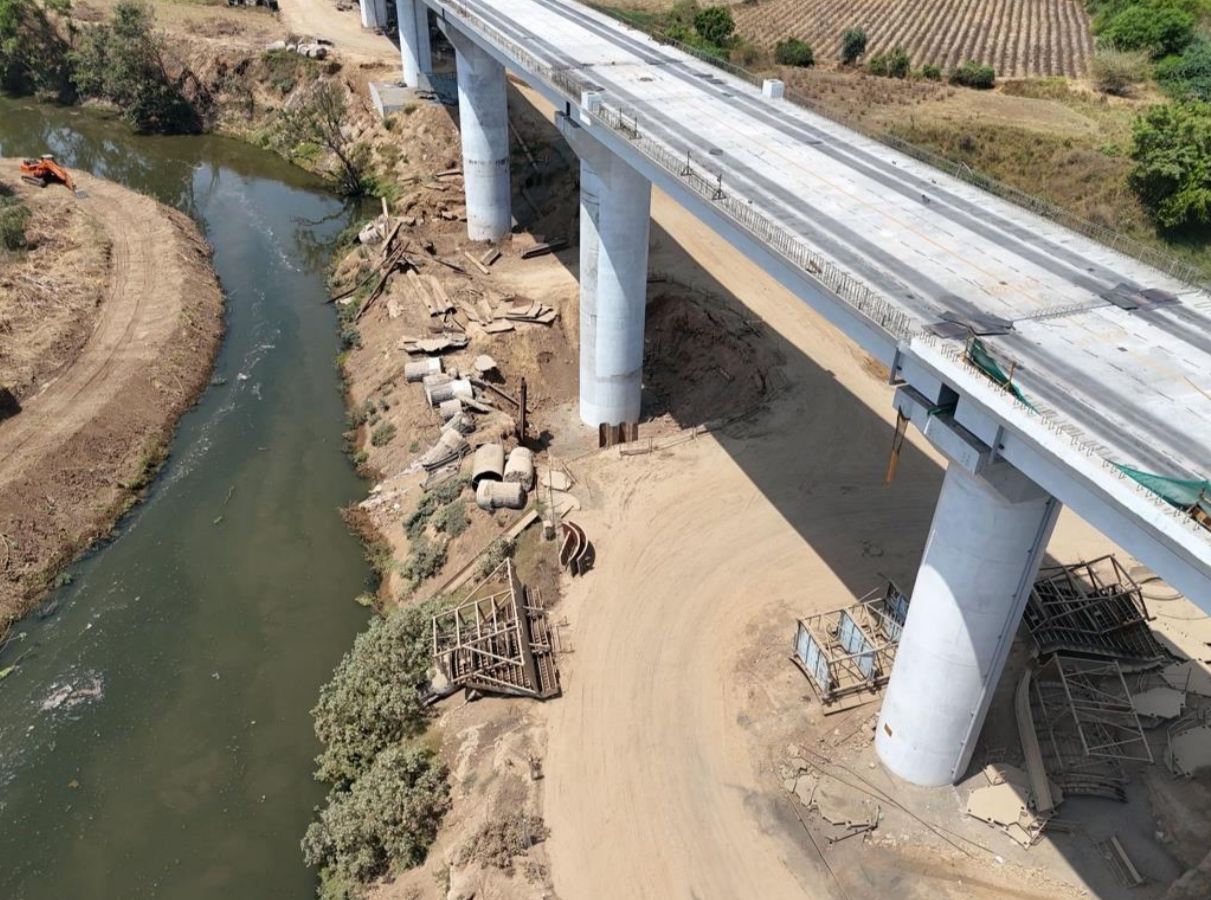
The National High Speed Rail Corporation Limited, overseeing the Mumbai-Ahmedabad High-Speed Rail project, submitted documents affirming compliance with environmental norms and committed to removing temporary obstructions by June 15, 2025, or earlier if rain occurs. They will also undertake desilting and stabilization in affected areas. The Vadodara Municipal Corporation identified 38 sewage and stormwater outfalls along a 24-km stretch within city limits, though tributaries were not surveyed. Naturally activated meanders and stormwater ways should remain undisturbed, the committee noted.
Pending information includes a plantation action plan from the Forest Department, a wildlife rescue logbook from zoo authorities, and drone surveys of desilting works, the commitee said. Pollution from unregulated sewer waste and construction debris threatens the river’s ecosystem and agriculture. It stressed on preserving biodiversity, particularly for crocodiles and turtles, and proposed a rehabilitation roadmap for rescued organisms. Flood management delays, including the Ajwa spillway and incomplete desilting, raise concerns about monsoon preparedness.
The committee proposed actionable measures: prioritize eco-engineering like coco logs on erosional banks while avoiding wildlife dens, plant vetiver grass at 3-foot intervals, remove invasive species, and plant native trees on upper banks. Debris beyond riverbanks should be cleared, and a construction and demolition waste processing plant established. Strict penalties for illegal dumping, mapping of floodplain structures, public awareness campaigns, regular drone-based monitoring, and water quality assessments were also recommended.
In other critical recommendations, the committee emphasized on the need for scientific and ecological restoration of the river system, extending beyond current government initiatives, advocating for the reversion of mapped floodplains, wetlands, ponds, and tributaries to their natural state, ensuring a holistic approach to river rehabilitation. 
Recommending removing debris, municipal solid waste, and sewage, applying ecological engineering techniques across the Vishwamitri watershed, from Pavagadh to the Gulf of Khambat, the committe said, a drone survey of tributaries, waterways, and wetlands should be carried to scientifically analyze the river's condition. It identified multiple locations along the river and its tributaries where bottlenecks and obstructions need urgent removal, including areas in Sama, Bharwadvaas, and Akota crematorium.
Highlighting the importance of restoring meanders, reconnecting tributaries, and ensuring that natural stormwater flows remain unobstructed, the committee said, town planning schemes and development projects must integrate the river ecosystem to prevent further ecological damage. 
The  committee suggested a new administrative agency dedicated to monitoring and implementing a Riverine Plan for demarcated floodplain areas. Until this plan is officially sanctioned, no development projects should be approved within these sensitive zones.  To prevent future damage, the Vadodara Municipal Corporation (VMC) must devise a system ensuring proper waste disposal and restricting illegal dumping in the river, it said. It stressed on the need for topographical studies before increasing road levels, as excessive paving could worsen waterlogging and groundwater depletion.  
In addition, the committee also emphasized the recruitment of permanent staff with technical expertise and regular capacity-building workshops for officials, ensuring sustainable implementation of restoration strategies.  It believes that current actions by the VMC and Irrigation Department fall short of addressing the full scale of required restoration. 
Insisting that there is a need to track progress and ensure that the directives from the National Green Tribunal (NGT) are implemented in letter and spirit, the committee members -- environmental activists and urban planners Neha Sarwate, Rohit Prajapati, Dr. Ranjitsinh Devkar, Dr. Jitendra Gavali, and Mitesh Panchal -- urged immediate policy intervention and strict regulatory enforcement to revive the Vishwamitri River for future generations. 
Vishwamitri’s challenges reflect global river pollution and habitat loss issues, they concluded. 

Comments

TRENDING

From McKinsey to PwC: Two decades ago, same warning on GIFT City’s fragile foundations

This blog continues  my story , “A revdi-funded dream? Tax breaks, hype, unease: PwC reveals GIFT City’s fragile foundations.”  Ironic though it may seem, what PriceWaterhouseCoopers (PwC) recently observed about the lack of a talent pool in Prime Minister Narendra Modi ’s dream project, the Gujarat International Finance Tec-City (GIFT City), had already been predicted by another global consultant — McKinsey & Company — not days or months ago, but more than two decades earlier in what was then described as a feasibility study.

A Hindu alternative to Valentine's Day? 'Shiv-Parvati was first love marriage in Universe'

The other day, I was searching on Google a quote on Maha Shivratri which I wanted to send to someone, a confirmed Shiv Bhakt, quite close to me -- with an underlying message to act positively instead of being negative. On top of the search, I chanced upon an article in, imagine!, a Nashik Corporation site which offered me something very unusual.  I don't know who owns this site, for there is nothing on it in the About Us link. It merely says, the Nashik Corporation  site   "is an educational and news website of the municipal corporation. Today, education and payment of tax are completely online." It goes on to add, "So we provide some of the latest information about Property Tax, Water Tax, Marriage Certificate, Caste Certificate, etc. So all taxpayer can get all information of their municipal in a single place.some facts about legal and financial issues that different city corporations face, but I was least interested in them."  Surely, this didn't interest...

Disappearing schools: India's education landscape undergoing massive changes

   The other day, I received a message from education rights activist Mitra Ranjan, who claims that a whopping one lakh schools across India have been closed down or merged. This seemed unbelievable at first sight. The message from the activist, who is from the advocacy group Right to Education (RTE) Forum, states that this is happening as part of the implementation of the National Education Policy (NEP), 2020, which floated the idea of school integration/consolidation.

'Shameful lies': Ambedkar defamed, Godse glorified? Dalit leader vows legal battle

A few days back, I was a little surprised to receive a Hindi article in plain text format from veteran Gujarat Dalit rights leader Valjibhai Patel , known for waging many legal battles under the banner of the Council of Social Justice (CSJ) on behalf of socially oppressed communities.

From Gujarat to Gaza: Tracing India’s growing complicity in Israel’s war economy

I have been forwarded a report titled “Profit and Genocide: Indian Investments in Israel”. It has been prepared by the advocacy group Centre for Financial Accountability (CFA) and authored by Hajira Puthige. The report was released following the Government of India’s signing of a Bilateral Investment Treaty (BIT) with Israel.

India’s expanding coal-to-chemical push raises concerns amidst global exit call

  As the world prepares for  COP30  in  Belém , a new global report has raised serious alarms about the continued expansion of coal-based industries, particularly in India and China. The 2025  Global Coal Exit List  (GCEL), released by Germany-based NGO  Urgewald  and 48 partners, reveals a worrying rise in  coal-to-chemical projects  and  captive power plants  despite mounting evidence of climate risks and tightening international finance restrictions.

Rs 2 treatment for cancer? Treat with utter caution, especially many times forwards on WhatsApp

The other day when I received a WhatsApp forward (it said "forwarded many times"), I got terribly worked up, even though I shouldn't have done it. I generally don't like such forwards as these seek to spread rumours. In fact, shouting out, I said, "Another nonsense from WhatsApp University... Why forward such unverified things?"

Grey memories, silent youth: What Ahmedabad Emergency anniversary meet revealed

  Recently, I attended what I would call a veterans’ meet — a gathering to recall the  Emergency  imposed by  Indira Gandhi , whose resistance is said to have begun in  Ahmedabad  on  October 12, 1975 . At that time,  Gujarat  was one of the two states described as an “island of freedom.” It was ruled by  Janata Morcha  chief minister  Babubhai Jashbhai Patel . The other such “island” was  Tamil Nadu .

Varnashram Dharma: How Gandhi's views evolved, moved closer to Ambedkar's

  By Rajiv Shah  My interaction with critics and supporters of Mahatma Gandhi, ranging from those who consider themselves diehard Gandhians to Left-wing and Dalit intellectuals, has revealed that in the long arc of his public life, few issues expose his philosophical tensions more than his shifting stance on Varnashram Dharma—the ancient Hindu concept that society should be divided into four varnas, or classes, based on duties and aptitudes.